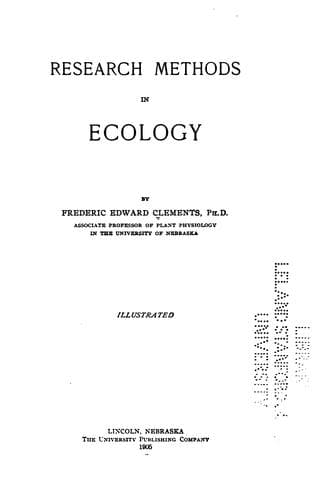
Research methods in ecologyClements, Frederic E. (Frederic Edward)
Science
Research methods in ecology
Clements, Frederic E. (Frederic Edward)
Plant ecology; Plant ecology -- Methodology
Various categories of association may be distinguished, according to the
dominant physical factor concerned or the point of view taken. These
will fall into two series, as we consider the relation of plant to plant
with reference to some object or characteristic, or the grouping of
plants together in response to some dominant factor. In the first series
may be placed association with reference to substratum, to the ground
(occupation), and to invasion; in the second belong light and
water-content association. It should be noted that these are all actual
associations in nature, and not concepts such as the vegetation form,
within which plants from widely different associations may be
classified. Naturally, it does not follow that it is not logical or
valuable to group together those plants, such as hydrophytes,
sciophytes, hysterophytes, etc., which have a common relation to some
factor, but belong to different formations.
=254. Stratum association.= Plants manifest independent or dependent
association with reference to the stratum to which they are attached and
from which they derive food or support. Independent association is
exhibited by those holophytic species of a formation which are entirely
independent of each other with respect to mechanical support or
nutrition. It is characteristic of the greater number of the constituent
species of formations. Dependent association is manifested in the
relation between host and parasite, stratum and epiphyte, support and
liane. Warming[24] has distinguished six kinds of associations:
parasitism, helotism, mutualism, epiphytism, lianism, and commensalism.
Commensalism corresponds to the primary principle of association which
has given rise to vegetation. Homogeneous commensalism is the term
applied to social exclusive plants, in which the patch is composed of a
single species. Such association is extremely rare in nature, and if the
most minute forms be considered, probably never occurs. On the other
hand, heterogeneous commensalism, in which individuals of more than one
species are present, is everywhere typical of vegetation. Warming
regards saprophytism merely as a specialized kind of parasitism, an
opinion that may well be defended. Helotism, however, is also a mere
modification of parasitism, if it is not indeed parasitism pure and
simple. Mutualism is an altogether vague concept, including parasites,
epiphytes, and endophytes of doubtful physiological relation. Pound and
Clements[25] treated lianes, parasites, and saprophytes as vegetation
forms, relating herbaceous creepers and twiners to the lianes, and
dividing the fungi and lichens into nine groups. Whatever the value of
these divisions may be from the standpoint of vegetation forms, they
represent the same relation between plant and nutritive stratum, and
with respect to association should be merged in one group. Schimper[26]
was the first to perceive the essential similarity of all such groups
from the standpoint of association.
Public-domain text, read in full here on John Shaqi.
Reviews
Reviews
No reviews yet
Be the first to share your thoughts on this work.
Elsewhere in the archive
Join the Discussion
Join the discussion
Sign in to leave a comment or review.
Sign InorCreate an account