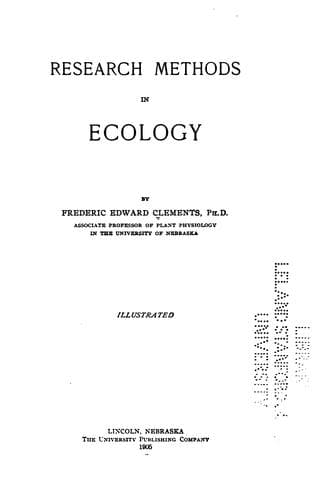
Research methods in ecologyClements, Frederic E. (Frederic Edward)
Science
Research methods in ecology
Clements, Frederic E. (Frederic Edward)
Plant ecology; Plant ecology -- Methodology
The phase of experimental ecology which has to do with the plant has
well been called experimental evolution. While this is a field almost
wholly without development at present, there can be little question that
it is to be one of the most fertile and important in the future.
Attention will be directed first to those forms which are undergoing
modification at the present time. The cause and direction of change will
be ascertained, and its amount and rapidity measured by biometrical
methods. The next step will be to actually change the habitat of
representative types, and to determine for each the general trend of
adaptation, as well as the exact details. By means of the methods used
and the results obtained in these investigations, it will be possible to
attack the much more difficult problem of retracing the development of
species already definitely constituted. This will be accomplished by the
study of the derived and the supposed ancestral form, but owing to the
great preponderance of evolution over reversion, the study of the
ancestral form will yield much more valuable results.
The general application of the methods of experimental ecology will mark
a new era in the study of evolution. There has been a surplus of
literary investigation, but altogether too little actual experiment. The
great value of De Vries’ work lies not in the importance of the results
obtained, but in calling attention to the unique importance of
experimental methods in contributing to a knowledge of evolution. The
development of the latter has been greatly hindered by the dearth of
actual facts, and by a marked tendency to compensate for this by
verbiage and dogmatism. This is well illustrated by the present position
of the “mutation theory,” which, so far as the evidence available is
concerned, is merely a working hypothesis. An incredible amount of bias
and looseness of thought have characterized the discussion of evolution.
It is earnestly to be hoped that the future will bring more work and
less argument, and that the literary evolutionists will become less and
less reluctant to leave the relative merits of variation and mutation to
experiment.
Public-domain text, read in full here on John Shaqi.
Reviews
Reviews
No reviews yet
Be the first to share your thoughts on this work.
Join the Discussion
Join the discussion
Sign in to leave a comment or review.
Sign InorCreate an account