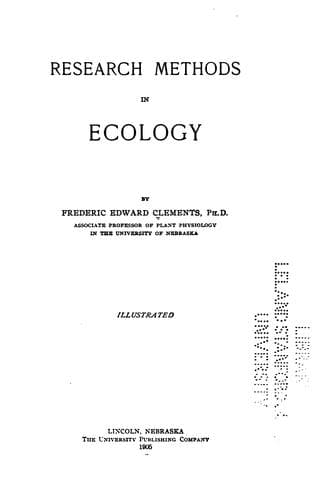
Research methods in ecologyClements, Frederic E. (Frederic Edward)
Science
Research methods in ecology
Clements, Frederic E. (Frederic Edward)
Plant ecology; Plant ecology -- Methodology
=295. Succession in colluvial soils.= Colluvial deposits owe their
aggregation solely or chiefly to the action of gravity. They are the
immediate result of the disintegration of cliffs, ledges, and mountain
sides, decomposition appearing later as a secondary factor. The masses
and particles arising from disintegration are extremely variable in
size, but they agree as a rule in their angular shape. The typical
example of the colluvial deposit is the talus, which may originate from
any kind of rock, and contains pieces of all sizes. Gravel slides differ
from ordinary talus in being composed of more uniform particles, which
are worn round by slipping down the slope in response to gravity and
surface wash. Boulder fields are to be regarded as talus produced by
weathering under the influence of joints, resulting in huge boulders
which become more and more rounded under the action of water and
gravity. This statement applies to those fields which are in connection
with some cliff that is weathering in this fashion; otherwise, boulder
fields are of aqueous or glacial origin. The character of the
successions in talus will depend upon the kind of rock in the latter. If
the rock is igneous or metamorphic, decomposition will be slow, and the
soil will be dysgeogenous. Successions on such talus consist of many
stages, and the formations are for a long time open and xerophytic. In
talus formed from sedimentary rocks, especially shales, limestones, and
calcareous sandstones, decomposition is much more rapid, and the
successions are simpler and more mesophytic.
Public-domain text, read in full here on John Shaqi.
Reviews
Reviews
No reviews yet
Be the first to share your thoughts on this work.
Elsewhere in the archive
Join the Discussion
Join the discussion
Sign in to leave a comment or review.
Sign InorCreate an account