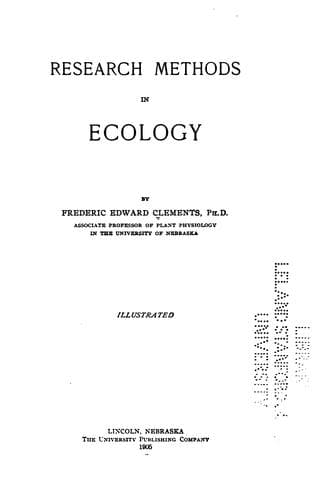
Research methods in ecologyClements, Frederic E. (Frederic Edward)
Science
Research methods in ecology
Clements, Frederic E. (Frederic Edward)
Plant ecology; Plant ecology -- Methodology
=50. The availability of soil water.= The amount of water present in a
soil is no real index to the influence of water-content as a factor of
the habitat. All soils contain more water than can be absorbed by the
plants which grow in them. This residual water, which is not available
for use, varies for different soils. It is greatest in the compact
soils, such as clay and loam, and least in the loose ones, as sand and
gravel. It differs, but to a much less degree, from one species to
another. A plant of xerophytic tendency is naturally able to remove more
water from the same soil than one of mesophytic or hydrophytic
character. As the species of a particular formation owe their
association chiefly to their common relation to the water-content of the
habitat, this difference is of little importance in the field. In
comparing the structure of formations, and especially that of the plants
which are found in them, the need to distinguish the available water
from the total amount is imperative. Thus, water-contents of 15 per cent
in gravel and in clay are in no wise comparable. A coarse gravel
containing 15 per cent of water is practically saturated. The plants
which grow upon it are mesophytes of a strong hydrophytic tendency, and
they are able to use 14½ or all but .5 out of the 15 per cent of water.
In a compact clay, only 3½ of the 15 per cent are available, and the
plants growing in it are marked xerophytes. It is evident that a
knowledge merely of the physical water-content is actually misleading in
such cases, and this holds true of comparisons of any soils which differ
considerably in texture. After one has determined the physiological
water for the great groups of soils, it is more or less possible to
estimate the amounts in the various types of each. As an analysis is
necessary to show how close soils are in texture, this is little better
than a guess, and for accurate work it is indispensable that the
available water be determined for each habitat. Within the same
formation, however, after this has once been carefully ascertained, it
is perfectly satisfactory to convert physical water-content into
available by subtracting the non-available water, which under normal
conditions in the field remains practically the same.
The importance of knowing the available water is even greater in those
habitats in which salts, acids, cold, or other factors than the
molecular attraction of soil particles increase the amount of water
which the plant can not absorb. Few careful investigations of such soils
have yet been made, and the relation of available to non-available water
in them is almost entirely unknown. It is probable that the phenomena in
some of these will be found to be produced by other factors.
Public-domain text, read in full here on John Shaqi.
Reviews
Reviews
No reviews yet
Be the first to share your thoughts on this work.
Join the Discussion
Join the discussion
Sign in to leave a comment or review.
Sign InorCreate an account