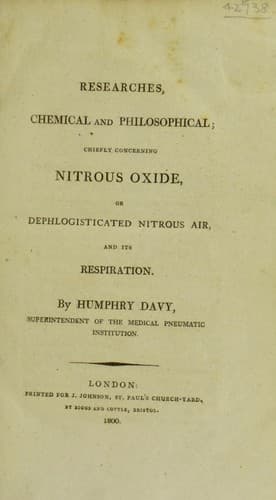
Researches Chemical and Philosophical; Chiefly concerning nitrous oxide: or dephlogisticated nitrous air and its respirationDavy, Humphry, Sir
Science
Researches Chemical and Philosophical; Chiefly concerning nitrous oxide: or dephlogisticated nitrous air and its respiration
Davy, Humphry, Sir
Nitrous oxide
When muriatic acid was introduced into it, confined by mercury, a rapid
effervescence took place. Part of the gas disengaged was sulphureous
acid, and carbonic acid; the remainder was nitrous oxide.
_b._ I made a number of experiments upon salts procured in the manner
I have just described, with a view to obtain the compound of nitrous
oxide and potash, free from admixture of other salts.
When the mixed salt was boiled in alcohol or ether, no part of it
appeared to be dissolved. Finding that little or no gas was given out
during the ebullition of concentrated solutions of the mixed salts,
I attempted to separate the sulphate, sulphite, and carbonate of
potash, from the combination of nitrous oxide and potash, by successive
evaporations and crystalisations. But though in this way it was nearly
freed from sulphate of potash, yet the extreme and nearly equal
solubility of the other salts, prevented me from completely separating
them from each other.
By exposing, however, very finely pulverised sulphite of potash,
mingled with alkali, for a great length of time to nitrous gas, it was
almost wholly converted into sulphate; and after the separation of
this solution, evaporation, and crystalisation, at a low temperature,
I obtained the new combination, mingled with very little carbonate of
potash, and still less of sulphite.
The minute quantity of sulphite chiefly appeared in very small
crystals; distinct from the mass of salt, which possessed no regular
crystalisation, and was almost wholly composed of the new compound,
intimated mingled with a little carbonate. The new compound, as nearly
as I could estimate from the quantity of nitrous oxide absorbed,
consisted of about 3 alkali, to 1 of nitrous oxide, by weight.
It exhibited the following properties:
1. Its taste was caustic, and possessed of a pungency different from
either potash or carbonate of potash.
2. It rendered vegetable blues green, which might possibly depend upon
the carbonate of potash mixed with it.
3. Pulverised charcoal mingled with a few grains of it, and inflamed,
burnt with flight scintillations. Projected into zinc in a state of
fusion, a slight inflammation was produced.
4. When either sulphuric, muriatic, or nitric acid was introduced to
it under mercury, it gave out nitrous oxide, mingled with a little
carbonic acid.
5. Thrown into a solution of sulphurated hydrogene, gas was disengaged
from it, but in quantities too minute to be examined.
6. When carbonic acid was thrown into a solution of it in water, gas
was disengaged; on examination it proved to be nitrous oxide.
7. A concentrated solution of it kept in ebullition in a cylinder,
confined by mercury, gave out a few globules of gas, which were too
minute to be examined, and probably consisted of common air previously
contained in the water.
Public-domain text, read in full here on John Shaqi.
Reviews
Reviews
No reviews yet
Be the first to share your thoughts on this work.
Elsewhere in the archive
Join the Discussion
Join the discussion
Sign in to leave a comment or review.
Sign InorCreate an account