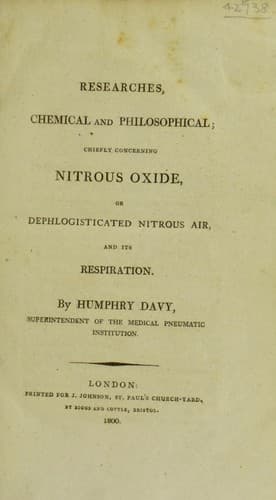
Researches Chemical and Philosophical; Chiefly concerning nitrous oxide: or dephlogisticated nitrous air and its respirationDavy, Humphry, Sir
Science
Researches Chemical and Philosophical; Chiefly concerning nitrous oxide: or dephlogisticated nitrous air and its respiration
Davy, Humphry, Sir
Nitrous oxide
To ascertain whether any change in the constitution of the nitrous
oxide had been produced by the condensation, I introduced a small
quantity of sulphite of potash, with excess of alkali, that had
absorbed nitrous oxide, into a long and thin cylindrical tube filled
with mercury; and inclining it at an angle of 35° with the plane of the
mercury, applied the heat of a spirit lamp to that part of the tube
containing the salts; when the glass became very hot, gas was given out
with rapidity; in less than a minute the tube was full. This gas was
transfered into another tube, and examined; it proved to be nitrous
oxide in its highest state of purity;[157] for a portion of it absorbed
by common water, left no more than a residuum of ¹/₁₅, and sulphur
burnt in it with a vivid rose-colored flame.
[157] Hence we learn that sulphite of potash, when strongly heated,
does not decompose nitrous oxide, even in the _nascent state_.
Being now satisfied that the alkalies were capable of combining with
nitrous oxide; to investigate with precision the nature of these new
compounds, I proceeded in the following manner.
VII. _Combination of Nitrous Oxide with Potash._
_a._ Into a solution of sulphite of potash, which had been made by
passing sulphureous acid gas from a mercurial airholder into caustic
potash dissolved in water, I introduced 17 grains of dry potash. The
whole evaporated at a low temperature, gave 143 grains of salt. This
salt was not _wholly_ composed of sulphite of potash and potash; it
contained as well, a minute quantity of carbonate, and sulphate of
potash, formed during the evaporation.[158]
[158] See the excellent memoir of Fourcroy and Vauquelin on the
sulphureous acid, and its combinations. Annales de Chimie, ii, 54. Or
Nicholson’s Phil. Journal, vol. i, pag. 313.
120 grains of it finely pulverised, and retaining the water of
crystalisation, were exposed to 15 cubic inches of nitrous gas, over
mercury. The nitrous gas diminished with great rapidity, and in three
hours a cubic inch and nine tenths only remained, which consisted of
nearly one third nitrous oxide, and two thirds nitrogene that had
pre-existed in the nitrous gas. The increase of weight of the salt
could not be determined, as some of it was lost by adhering to the
vessel in which the combination was effected, and to the mercury. It
presented no distinct series of crystalisations, even when examined
by the magnifier; rendered green vegetable blues, and its taste was
very different from that of the remaining quantity of salt that had
been exposed to the atmosphere. A portion of it strongly heated over
mercury, gave out gas with great rapidity, which had all the properties
of the purest nitrous oxide.
When water was poured upon some of it, no gas was given out, and the
whole was equably and gradually dissolved. Alcohol, as well as ether,
appeared incapable of dissolving any part of it.
Public-domain text, read in full here on John Shaqi.
Reviews
Reviews
No reviews yet
Be the first to share your thoughts on this work.
Elsewhere in the archive
Join the Discussion
Join the discussion
Sign in to leave a comment or review.
Sign InorCreate an account