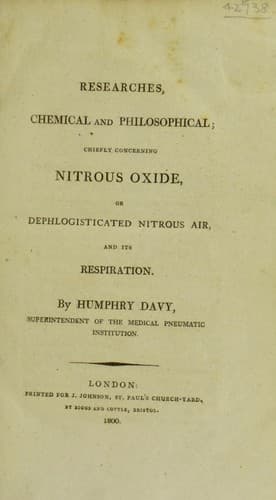
Researches Chemical and Philosophical; Chiefly concerning nitrous oxide: or dephlogisticated nitrous air and its respirationDavy, Humphry, Sir
Science
Researches Chemical and Philosophical; Chiefly concerning nitrous oxide: or dephlogisticated nitrous air and its respiration
Davy, Humphry, Sir
Nitrous oxide
_c._ In the experiments made to ascertain these properties all the salt
was expended, otherwise I should have endeavoured to ascertain what
quantity of gas would have been liberated by heat from a given weight;
and likewise what would have been the effects of admixture of it with
oil. When some of the mixed salt was mingled with oil of turpentine,
part of it was dissolved, and the fluid became white; but no gas was
given out. On this coarse experiment, however, I cannot place much
dependance. If the combination of nitrous oxide and potash is capable
of combining with oil without decomposition, barytes and strontian[159]
will probably separate the oil from it, and thus it may possibly be
obtained in a state of purity.
[159] Unless the sum of affinity of the potash, oil, nitrous oxide, and
earths, should be inch as to enable the nitrous oxide to combine with
the earth, whilst the oil and alkali remained in combination, & c.
In a rough experiment made on the conversion of nitrous gas into
nitrous oxide, by concentrated solution of sulphite of potash with
excess of alkali, very little of the nitrous oxide was absorbed. Hence
it is probable that water lessens the affinity of potash for nascent
nitrous oxide.
VIII. _Combination of Nitrous Oxide with Soda._
The union of nitrous oxide with soda is effected in the same manner
as with potash. The alkali, mingled by solution and evaporation, with
either sulphite of soda, or of potash, is exposed to nitrous gas; the
nitrous oxide is condensed by it at the moment of generation, and the
combination effected.
As far as I have been able to observe, nitrous oxide is not absorbed to
so great an extent by soda, as potash.
I have not yet been able to obtain the combination of nitrous
oxide with soda in its pure state. To the attainment of this end,
difficulties identical with those noticed in the last section present
themselves. It is extremely difficult to procure the soda perfectly
free from carbonic acid, and though by using sulphite of potash the
sulphate formed is easily separated, yet still evaporation and
crystalisation will not disengage the sulphite and carbonate from the
new compound.
The compound of soda and nitrous oxide, mingled with a little sulphite
and carbonate of soda, was rapidly soluble, both in warm and cold
water, without effervescence. Its solution, heated to ebullition, gave
out no gas. The taste of the solid salt was caustic, and more acrid
than that of the mixture of carbonate and sulphite of soda. When cast
upon zinc in fusion, it burnt with a white flame. When heated to 400°
or 500°, it gave out nitrous oxide with rapidity. Nitrous oxide was
expelled from it by the sulphuric, muriatic, and carbonic acids, _I
believe_, by sulphurated hydrogene.[160]
[160] For when a little of the mixed salt was introduced into a
solution of sulphurated hydrogene, globules of gas were given out
during the solution.
IX. _Combination of Nitrous Oxide with Ammoniac._
Public-domain text, read in full here on John Shaqi.
Reviews
Reviews
No reviews yet
Be the first to share your thoughts on this work.
Elsewhere in the archive
Join the Discussion
Join the discussion
Sign in to leave a comment or review.
Sign InorCreate an account