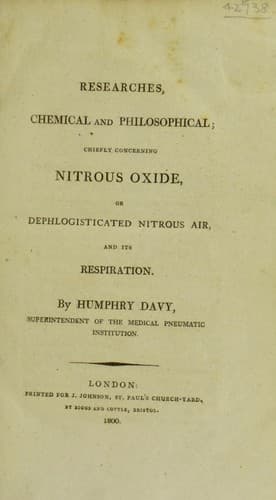
Researches Chemical and Philosophical; Chiefly concerning nitrous oxide: or dephlogisticated nitrous air and its respirationDavy, Humphry, Sir
Science
Researches Chemical and Philosophical; Chiefly concerning nitrous oxide: or dephlogisticated nitrous air and its respiration
Davy, Humphry, Sir
Nitrous oxide
I attempted to effect this combination by converting nitrous gas into
nitrous oxide, by sulphite of ammoniac, wetted with strong solution of
caustic ammoniac; but without success; for the whole of the nitrous
oxide produced remained in a free state.
When I exposed sulphite of potash, mingled by solution and evaporation
with highly alkaline carbonate of ammoniac,[161] to nitrous gas, the
diminution was nearly one fourth more than if pure sulphite of potash
had been employed. Hence it appears most likely that ammoniac is
capable of combination with nitrous oxide in the nascent state.
[161] Carbonate of ammoniac formed at a high temperature, containing
near 60 per cent alkali, and capable of combining with small quantities
of acids without giving out its carbonic acid. Of this salt a
particular account will be given in the experiments on the ammoniacal
salts, which I have often mentioned in the course of this work.
In the experiments on the conversion of nitrous gas into nitrous oxide,
by nascent hydrogene, and by sulphurated hydrogene, Res. I. Divis.
V. probably the water formed at the same time with the ammoniac
and nitrous oxide, prevented them from entering into combination;
_possibly_ the peculiar compound was formed, but in quantities so
minute as not to be distinguished from simple ammoniac;[162] for even
the existence of ammoniac in these processes, is but barely perceptible.
If it should be proved by future experiments, that in the decomposition
of nitrous gas by nascent hydrogene, a peculiar compound of nitrous
oxide, water and ammoniac, is formed, it will afford proofs in favor of
the doctrine of predisposing affinity;[163] for then this decomposition
might be supposed to depend upon the disposition of oxygene, hydrogene
and nitrogene to assume the states of combination in which they might
form a triple compound, of water, nitrous oxide, and ammoniac.
[162] It may not be amiss to mention some appearances taking place in
the decomposition of nitrous gas by sulphurated hydrogene, though it
is useless to theorise concerning them. The sulphur deposited is at
first yellow; as the process proceeds, it becomes white, and in some
instances I have suspected a diminution of it.
[163] Predisposing affinity, the existence of which at first
consideration it is difficult to admit, may be easily accounted for
by _supposing_ the attractions of the simple principles of compound
substances. And this doctrine will apply in all instances where the
constitution of bodies is known. Predisposing affinity ought not to be
considered as the affinity of _non-existing_ bodies for each other; but
as the mutual affinity of their simple principles, disposing them to
assume new arrangements.
Nitrous oxide might probably be made to combine with ammoniac by
exposing a mixture of nitrous gas and aëriform ammoniac, to the
sulphites.
Public-domain text, read in full here on John Shaqi.
Reviews
Reviews
No reviews yet
Be the first to share your thoughts on this work.
Elsewhere in the archive
Join the Discussion
Join the discussion
Sign in to leave a comment or review.
Sign InorCreate an account