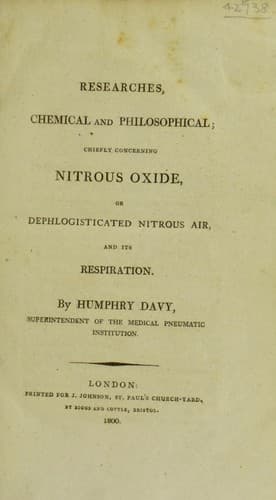
Researches Chemical and Philosophical; Chiefly concerning nitrous oxide: or dephlogisticated nitrous air and its respirationDavy, Humphry, Sir
Science
Researches Chemical and Philosophical; Chiefly concerning nitrous oxide: or dephlogisticated nitrous air and its respiration
Davy, Humphry, Sir
Nitrous oxide
With regard to the uses of these new compounds it is difficult to
form a guess. When they are obtained pure, and fully saturated with
nitrous oxide, on account of the low temperature at which their gas is
liberated, they will probably constitute detonating compounds. From
their facility of decomposition by the weaker acids, they may possibly
be used medicinally, if ever the evolution of nitrous oxide in the
stomach should be found beneficial in diseases.
XII. _The properties of Nitrous Oxide resemble those of Acids._
If we were inclined to generalise, and to place nitrous oxide among
a known class of bodies, its properties would certainly induce us
to consider it as more analogous to the acids than to any other
substances; for it is capable of uniting with water and the alkalies,
and is insoluble in most of the acids. It differs, however, from the
stronger acids, in not possessing the sour taste,[165] and the power
of reddening vegetable blues: and from both the stronger and weaker
acids, in not being combinable when in a perfectly free state, at
common temperatures, with the alkalies. If it should be proved by
future experiments, that condensation by cold gave it the capability of
immediately forming neutro-saline compounds with the alkalies; it ought
to be considered as the weakest of the acids. Till those experiments
are made, its extraordinary chemical and physiological properties are
sufficient to induce us to consider it as a body _sui generis_.
[165] The different persons who have respired nitrous oxide have, as
will be seen hereafter, given different accounts of the taste; the
greater number have called it sweet, some metallic. One of my friends,
in a letter to me dated Nov. 13, 1799, containing a detail of some
experiments made on the respiration of nitrous oxide, at Birmingham,
denotes the taste of it by the term “sweetish faintly acidulous.” To
me the taste both of the gas and of its solution in water, has always
appeared faintly sweetish.
It is a singular fact that nitrous gas, which contains in its
composition a quantity of oxygene so much greater than nitrous oxide,
should nevertheless possess no acid properties. It is uncombinable with
alkalies, very little soluble in water, and absorbable by the acids.
DIVISION II.
_On the DECOMPOSITION of NITROUS OXIDE by COMBUSTIBLE
BODIES. Its ANALYSIS. OBSERVATIONS on the different
combinations of OXYGENE and NITROGENE._
I. _Preliminaries._
From the phænomena mentioned in Res. I. Divis. III.[166] it appears
that the combustible bodies burn in nitrous oxide at certain
temperatures. The experiments in this Division were instituted for the
purpose of investigating the precise nature of these combustions, with
a view of ascertaining exactly the composition of nitrous oxide.
[166] Section 2.
Public-domain text, read in full here on John Shaqi.
Reviews
Reviews
No reviews yet
Be the first to share your thoughts on this work.
Elsewhere in the archive
Join the Discussion
Join the discussion
Sign in to leave a comment or review.
Sign InorCreate an account