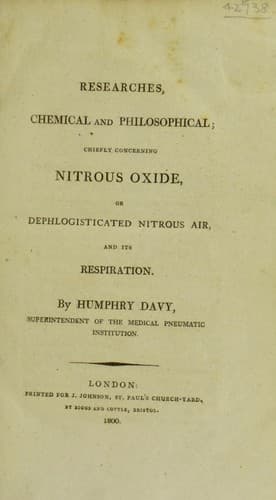
Researches Chemical and Philosophical; Chiefly concerning nitrous oxide: or dephlogisticated nitrous air and its respirationDavy, Humphry, Sir
Science
Researches Chemical and Philosophical; Chiefly concerning nitrous oxide: or dephlogisticated nitrous air and its respiration
Davy, Humphry, Sir
Nitrous oxide
It will be seen hereafter that very high temperatures are required for
the decomposition of nitrous oxide, by most of the combustible bodies,
and that in this process heat and light are produced to a very great
extent. These agents alone are possessed of a considerable power of
action on nitrous oxide; of which it is necessary to give an account,
that we may be able to understand the phænomena in the following
sections.
II. _Conversion of Nitrous Oxide into Nitrous Acid, and a Gas analogous
to Atmospheric Air, by Ignition._
_a._ Dr. Priestley asserts, that nitrous oxide exposed for a certain
time to the action of the electric spark, is rendered immiscible with
water, and capable of diminution with nitrous gas, without suffering
any alteration of volume; and likewise that the same changes are
effected in it by exposure to ignited incombustible bodies.[167]
[167] Vol. ii. pag. 91.
The Dutch chemists state, that the electric spark passed through
nitrous oxide, occasions a small diminution of its volume, and that the
gas remaining is analogous to common air.[168] They conclude that this
change depends on the separation of its constituent parts, oxygene and
nitrogene, from each other.
[168] Journal de Physique, tom. xliii, part ii. pag. 330. They effected
the same change by passing it through a heated tube. Dr. Priestley had
published an account of similar experiments more than two years before.
None of these chemists have suspected the production of nitrous acid in
this process.
_b._ Nitrous oxide undergoes no change whatever from the simple action
of light. I exposed some of it, confined by mercury, for many days to
this agent, often passing through it concentrated rays by means of a
small lens. When examined it appeared, as well as I could estimate, of
the same degree of purity as at the beginning of the experiment.
_c._ A temperature below that of ignition effects no alteration in the
constitution of nitrous oxide. I passed nitrous oxide from a retort
containing decomposing nitrate of ammoniac, through a green glass
tube, strongly heated in an air-furnace, but not suffered to undergo
ignition. The gas, received in a water apparatus exhibited the same
properties as the purest nitrous oxide; some of it absorbed by water,
left a residuum of not quite one thirteenth.
_d._ The action of the electric spark for a long while continued,
converts nitrous oxide into a gas analogous to atmospheric air, and
nitrous acid.
I passed about 150 strong shocks from a small Leyden phial, through 7
ten grain measures of pure nitrous oxide. After this it filled a space
rather less than six measures: the mercury was rendered white on the
top, as if it had been acted on by nitric acid. Six measures of nitrous
gas mingled with the residual gas of the experiment, over mercury
covered by a little water, gave red fumes, and rapid diminution. In
five minutes the volume of the gases nearly equalled ten. Thermometer
in this experiment was 58°.
Public-domain text, read in full here on John Shaqi.
Reviews
Reviews
No reviews yet
Be the first to share your thoughts on this work.
Elsewhere in the archive
Join the Discussion
Join the discussion
Sign in to leave a comment or review.
Sign InorCreate an account