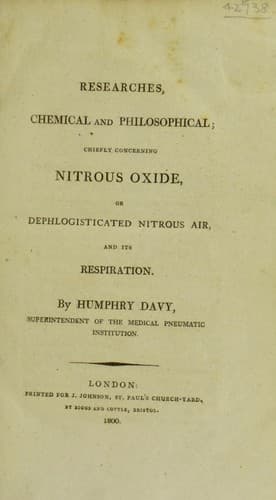
Researches Chemical and Philosophical; Chiefly concerning nitrous oxide: or dephlogisticated nitrous air and its respirationDavy, Humphry, Sir
Science
Researches Chemical and Philosophical; Chiefly concerning nitrous oxide: or dephlogisticated nitrous air and its respiration
Davy, Humphry, Sir
Nitrous oxide
Electric sparks were passed for an hour and half through 7 ten grain
measures of nitrous oxide over mercury covered with a little red
cabbage juice, previously saturated with nitrous oxide, and rendered
green by an alkali. After the process the gas filled a space equal
to rather more than six measures and half, and the juice was become
of a pale red. The gas was introduced into a small tube filled with
pure water, and agitated; no absorption was perceptible: 7 measures
of nitrous gas added to it gave red fumes, and after six minutes a
diminution to 9¼ nearly. 6½ measures of common air from the garden,
with 7 of nitrous gas, gave exactly 9.
In this experiment it was evident that nitrous oxide was converted into
a gas analogous to atmospheric air, at the same time that an acid was
formed. There could be little doubt but that this was the nitrous acid.
To ascertain it, however, with greater certainty, the electric spark
was passed through 6 measures of nitrous oxide, over a little solution
of green sulphate of iron, confined by mercury. As the process went on,
the color of the solution became rather darker. When the diminution
was complete, a little prussiate of iron was added to the solution. A
precipitate of pale blue prussiate of potash was produced.
_c._ Nitrous oxide was passed from decomposing nitrate of ammoniac,
through a porcelain tube well glazed inside and outside, strongly
ignited in an air-furnace, and communicating with the water apparatus.
The gas collected was rendered opaque by dense red vapor. It appeared
wholly unabsorbable by water. After the precipitation of its vapor, a
candle burnt in it with nearly the same brilliancy as in atmospheric
air. 20 measures of it that had been agitated in water immediately
after its production, mingled with 40 measures of nitrous gas,
diminished to about 47.5; whereas 20 measures that had remained
unagitated for some time after their generation, introduced to the same
quantity of nitrous gas, gave nearly 49. 20 measures of atmospheric
air, with 40 of the same nitrous gas, were condensed to 46.
The water with which the gas had been in contact, was strongly acid. A
little of it poured into a solution of green sulphate of iron, and then
mingled with prussian alkali, produced a green precipitate. Hence the
acid it contained was evidently nitrous.
That no source of error could have existed in this experiment from
fissure in the tube, I proved, by sending water through it whilst
ignited, after the process, from the same retort in which the nitrate
of ammoniac had been decomposed; a few globules of air only were
produced, not equal to one tenth of the volume of the water boiled, and
which were doubtless previously contained in it.
Public-domain text, read in full here on John Shaqi.
Reviews
Reviews
No reviews yet
Be the first to share your thoughts on this work.
Elsewhere in the archive
Join the Discussion
Join the discussion
Sign in to leave a comment or review.
Sign InorCreate an account