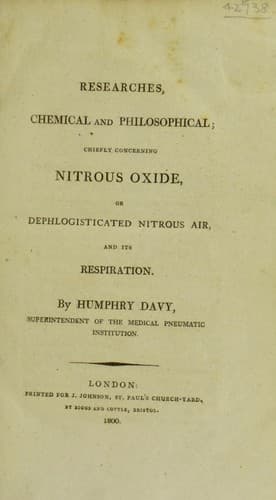
Researches Chemical and Philosophical; Chiefly concerning nitrous oxide: or dephlogisticated nitrous air and its respirationDavy, Humphry, Sir
Science
Researches Chemical and Philosophical; Chiefly concerning nitrous oxide: or dephlogisticated nitrous air and its respiration
Davy, Humphry, Sir
Nitrous oxide
I have repeated this experiment two or three times, with similar
results; whenever the air was agitated in water immediately after its
production, it gave _almost_ the same diminution with nitrous gas as
common air; when, on the contrary, it has been suffered to remain for
some time in contact with the phlogisticated nitrous acid suspended
in it, the condensation has been less with nitrous gas by five or
six hundred parts. Hence I am inclined to believe, that if it were
possible to condense all the nitrous acid formed, immediately after
its generation, so as to prevent it from absorbing oxygene from the
permanent gas, this gas would be found identical with the air of the
atmosphere.
The changes effected by fire on nitrous oxide are not analogous to
those produced by it in other bodies; for the power of this agent
seems generally _uniform_, either in wholly separating the constituent
principles of bodies from each other, or in making them enter into more
intimate union.[169]
[169] On the one hand, it decomposes ammoniac into hydrogene and
nitrogene, whilst on the other, it converts free oxygene and nitrogene
into nitrous acid. It likewise converts nitrous gas into nitrous acid
and nitrogene. Till we are more accurately acquainted with the nature
of heat, light, and electricity, we shall probably be unable to explain
these phænomena.
It is a singular phænomenon, that whilst it condenses one part of the
oxygene and nitrogene of nitrous oxide, in the form of nitrous acid;
it should cause the remainder to expand, in the state of atmospheric
air. Does not this fact afford an inference in favor of the _chemical_
composition of atmospheric air?
III. _Decomposition of Nitrous Oxide by Hydrogene, at the temperature
of Ignition._
In the following experiments on the decomposition of nitrous oxide
by hydrogene, the gases were carefully generated in the mercurial
apparatus, and their purity ascertained by the tests mentioned in
Research I. They were measured in small tubes graduated to grains, and
then transferred into the detonating tube, which was eight tenths of an
inch in diameter, and graduated to ten grain measures.
The space occupied by the gases being noted after the inflammation by
the electric shock, green muriate of iron, and prussiate of potash,
were successively introduced, to ascertain if any nitrous acid had
been formed. The absorption, if any took place, was marked, and the
gases transferred into a narrow grain measure tube, and their bulk and
composition accurately ascertained.
_b._ The hydrogene employed was procured from water by means of zinc
and sulphuric acid. 50 grain measures of it fired by the electric
spark, with 30 grain measures of oxygene containing one eleventh
nitrogene, gave a residuum of about 4. Nitrous gas mingled with those
4, indicated the presence of rather less than 1 of unconsumed oxygene.
In another experiment 23 of it, with 20 of the same oxygene left rather
more than 6 residuum.
Public-domain text, read in full here on John Shaqi.
Reviews
Reviews
No reviews yet
Be the first to share your thoughts on this work.
Elsewhere in the archive
Join the Discussion
Join the discussion
Sign in to leave a comment or review.
Sign InorCreate an account