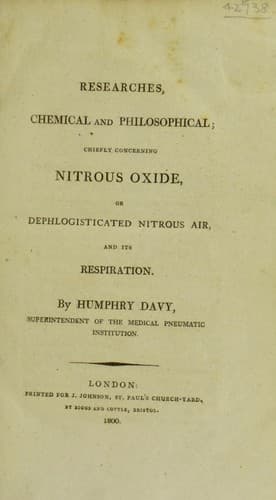
Researches Chemical and Philosophical; Chiefly concerning nitrous oxide: or dephlogisticated nitrous air and its respirationDavy, Humphry, Sir
Science
Researches Chemical and Philosophical; Chiefly concerning nitrous oxide: or dephlogisticated nitrous air and its respiration
Davy, Humphry, Sir
Nitrous oxide
The nitrous oxide was apparently pure, for it left a remainder of about
,05 only, when absorbed by common water.
_c._ 30 of hydrogene were fired with 40 of nitrous oxide; the
concussion was very great, and the light given out bright red; no
perceptible quantity of nitrous acid was formed; the residual gas
filled a space equal to 52. No part of it was absorbable by water, it
gave no diminution with nitrous gas, when it was mingled with a little
oxygene, and again acted on by the electric spark, an inflammation and
slight diminution was produced.
_d._ 33 of hydrogene were fired with 35 of nitrous oxide: nitrous acid
was produced in very minute quantity; the gas that remained was not
absorbable by water, and filled a space equal to 37 grains. Nitrous gas
mingled with these, underwent a very slight diminution.
_e._ 46 hydrogene were fired with 46 nitrous oxide. The quantity of
nitrous acid formed was just sufficient to tinge the white prussiate
of potash. The gases filled a space equal to 49, gave no perceptible
diminution with nitrous gas, and did not inflame with oxygene.
_f._ 40 hydrogene were fired with 39 nitrous oxide; no perceptible
quantity of nitrous acid was formed. The residual gas filled a space
equal to 41; was unabsorbable by water, underwent no diminution when
mingled with nitrous gas; or when acted on by the electric spark in
contact with oxygene.
_g._ 20 hydrogene were fired with 64 nitrous oxide; after detonation
the expansion of the gases was greater in this experiment than any of
the preceding ones; dense white fumes were observed in the cylinder,
and a slow contraction of volume took place. After a little green
muriate of iron had been admitted, the gases filled a space equal
to 73: prussiate of potash mingled with the muriate, gave a deeper
blue than in any of the preceding experiments. The residual gas was
unabsorbable by water: 65 of it, mingled with 65 of nitrous gas,
diminished to 93; whilst 65 of common air, with 65 of nitrous gas, gave
84.
_h._ 8 of hydrogene were fired with 54 of nitrous oxide; the same
phænomena as were observed in the last experiment took place; nitrous
acid was formed; after the absorption of which the residual gas filled
a space equal to 55. 50 of this, with an equal quantity of nitrous gas,
diminished to 76. In these processes the temperatures were from 56° to
61°.
These experiments are selected as the most accurate of nearly fifty,
made on the inflammation of different quantities of nitrous oxide and
hydrogene.
As Mr. Keir found muriatic acid in the fluid, produced by the
inflammation of oxygene and hydrogene in closed vessels, in Dr.
Priestley’s experiments, I preserved the residual gas of about 3 cubic
inches of nitrous oxide, that had been detonated at different times
with less than a cubic inch and half of hydrogene; but solution of
nitrate of silver was not clouded when agitated in this gas, nor when
introduced into the detonating tube in which the inflammation had been
made.
Public-domain text, read in full here on John Shaqi.
Reviews
Reviews
No reviews yet
Be the first to share your thoughts on this work.
Elsewhere in the archive
Join the Discussion
Join the discussion
Sign in to leave a comment or review.
Sign InorCreate an account