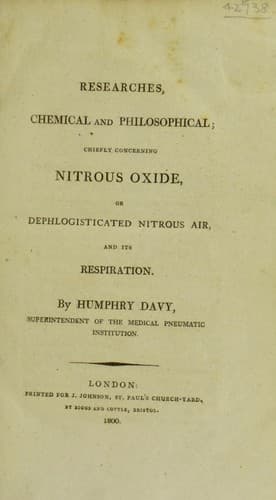
Researches Chemical and Philosophical; Chiefly concerning nitrous oxide: or dephlogisticated nitrous air and its respirationDavy, Humphry, Sir
Science
Researches Chemical and Philosophical; Chiefly concerning nitrous oxide: or dephlogisticated nitrous air and its respiration
Davy, Humphry, Sir
Nitrous oxide
From these experiments we learn that nitrous oxide is decomposable at
the heat of ignition, by hydrogene, in a variety of proportions.
When the quantity of hydrogene very little exceeds that of the nitrous
oxide, both of the gates disappear, water is produced, no nitrous acid
is formed, and the volume of nitrogene evolved is rather greater than
that of the nitrous oxide decomposed.
When the quantity of hydrogene is less than that of the nitrous oxide,
water, nitrous acid, oxygene and nitrogene, are generated in different
proportions; one part of the nitrous oxide is most probably wholly
decomposed by the hydrogene, and the other part converted into nitrous
acid and atmospheric air, in consequence of the ignition.
From experiments _c_, _d_, and _e_, the composition of nitrous oxide
may be deduced. In experiment _d_, 39 of nitrous oxide were decomposed
by 40 of hydrogene, and converted into 41 of nitrogene.
Now from _b_ it appears that 40 of hydrogene require for their
condensation about 20.8 of oxygene in volume; so that founding the
estimation upon the quantity of hydrogene consumed, 100 parts of
nitrous oxide would consist nearly of 63.1 of nitrogene, and 36.9 of
oxygene. But 41 of nitrogene weigh 12.4, Res. I. Div. I. Consequently,
deducing the composition of nitrous oxide from the quantity of
nitrogene evolved, 100 parts of it would consist of 63.5 nitrogene, and
36.5 oxygene.
These estimations are very little different from those which may be
deduced from the other experiments, and the coincidence is in favor of
their accuracy.
From the following experiment it appears that the temperature required
for the decomposition of nitrous oxide by hydrogene must be higher
than that which is necessary to produce the inflammation of hydrogene
with oxygene. I introduced into small tubes filled with equal parts of
nitrous oxide and hydrogene, standing on a surface of mercury, iron
wires ignited to different degrees, from the dull red to the vivid
white heat. The gases were always inflamed by the white and vivid
red heats; but never by the dull red heat, though the last uniformly
inflamed mixtures of oxygene and hydrogene, and atmospheric air and
hydrogene.
Dr. Priestley[170] first detonated together nitrous oxide and
hydrogene; his experiment was repeated by the Dutch chemists, who found
that when a small quantity of hydrogene was employed, the nitrous
oxide was partially converted into a gas analogous to common air. Their
estimation of its composition, which is not far removed from the truth,
was founded on this phænomenon.[171]
[170] Vol. ii. pag. 83.
[171] Journal de Physique, tom. xliii. part 2, pag. 331. They supposed
it to consist of about 37,5 oxygene, and 62,5 nitrogene. The nearness
of this account to the truth is singular, when we consider that they
were neither acquainted with the specific gravity of nitrous oxide, nor
with the production of nitrous acid in this experiment.
IV. _Decomposition of Nitrous Oxide by Phosphorus._
Public-domain text, read in full here on John Shaqi.
Reviews
Reviews
No reviews yet
Be the first to share your thoughts on this work.
Elsewhere in the archive
Join the Discussion
Join the discussion
Sign in to leave a comment or review.
Sign InorCreate an account