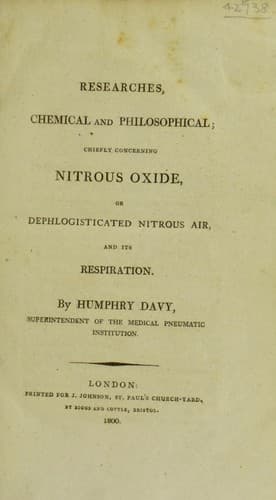
Researches Chemical and Philosophical; Chiefly concerning nitrous oxide: or dephlogisticated nitrous air and its respirationDavy, Humphry, Sir
Science
Researches Chemical and Philosophical; Chiefly concerning nitrous oxide: or dephlogisticated nitrous air and its respiration
Davy, Humphry, Sir
Nitrous oxide
_E._ 3. 47 nitrous oxide, and 14 sulphurated hydrogene, inflamed. After
the explosion, the gases filled a space nearly equal to 65; then white
fumes formed, and they gradually diminished to 52. On the introduction
of muriate of strontian, a copious white precipitate was produced; and
on the addition of water, no further absorption took place. To the
residual 52, about 20 of nitrous gas were added; they filled together a
space equal to about 67.
_c._ In none of the experiments made on the inflammation of sulphurated
hydrogene and nitrous oxide, could I ascertain with certainty the
precipitation of sulphur. In one or two processes the detonating tube
was rendered a little white at the points of contact with the mercury;
but this was most probably owing to the oxydation of the mercury,
either by the heated sulphuric acid formed, or from nitrous acid
produced by the ignition. The presence of nitrous acid I could not
ascertain in these processes by my usual tests, because the combustion
of sulphur over white prussiate of iron, converts it into light green.
When I introduced an inflamed taper into about 3 parts of sulphurated
hydrogene, and 2 parts of nitrous oxide, in which proportions they
could not have been fired by the electric spark, a blue flame passed
through them, and much sulphur was deposited on the sides of the
vessel. But this sulphur most probably owed its formation to the
decomposition of a portion of sulphurated hydrogene not burnt, by the
sulphureous acid formed from the combustion of the other portion.
We may then conclude with probability, that sulphurated hydrogene and
nitrous oxide will not decompose each other, when acted on by the
electric spark, unless their proportions are such as to enable the
whole of the sulphurated hydrogene to be decomposed, so that both of
its constituents may become oxygenated, by attracting oxygene from the
nitrous oxide: likewise, that when the sulphurated hydrogene is at its
_maximum_ of inflammation, the hydrogene and sulphur form with the
whole of the oxygene of nitrous oxide, water and sulphureous acid; _E._
2: whereas at its _minimum_ they produce water, and chiefly, _perhaps_
wholly, sulphuric acid; at the same time that the nitrous oxide
partially decomposed, is converted into nitrogene, and a gas analogous
to atmospheric air, or into nitrogene, nitrous acid, and atmospheric
air. _E._ 1. _E._ 3.
By pursuing those experiments, and using larger quantities of gas,
we may probably be able to ascertain from them with accuracy, the
composition of sulphuric and sulphureous acids.
I own I was disappointed in the results, for I expected to have been
able to ascertain from them, the relative affinities of sulphur, and
hydrogene for the oxygene of nitrous oxide, at the temperature of
ignition. I conjectured that nitrous oxide, mingled with excess of
sulphurated hydrogene, would have been decomposed, and one of the
principles of it evolved unaltered, as was the case with phosphorated
hydrogene.
Public-domain text, read in full here on John Shaqi.
Reviews
Reviews
No reviews yet
Be the first to share your thoughts on this work.
Elsewhere in the archive
Join the Discussion
Join the discussion
Sign in to leave a comment or review.
Sign InorCreate an account