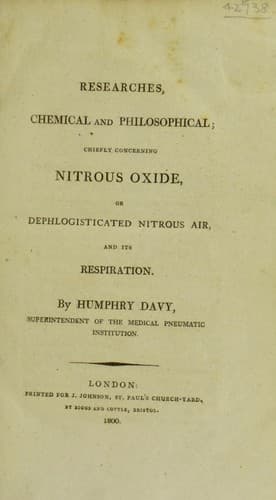
Researches Chemical and Philosophical; Chiefly concerning nitrous oxide: or dephlogisticated nitrous air and its respirationDavy, Humphry, Sir
Science
Researches Chemical and Philosophical; Chiefly concerning nitrous oxide: or dephlogisticated nitrous air and its respiration
Davy, Humphry, Sir
Nitrous oxide
If we estimate the composition of nitrous oxide from the quantity of
nitrogene produced in _E._ 2, it is composed of about 61 nitrogene, and
39 oxygene.
VIII. _Decomposition of Nitrous Oxide by Charcoal._
An account of the analysis of nitrous oxide by charcoal is given in
Res. I. Div. III. I have lately made two experiments on the combustion
of charcoal in nitrous oxide, in which every precaution was taken to
prevent the existence of sources of error. Of one of these I shall give
a detail.
_E._ Temperature being 51°, about a grain of charcoal, which had been
exposed for some hours to a red heat, was introduced whilst ignited,
under mercury, and transferred into a graduated jar, containing 3 cubic
inches of pure nitrous oxide, standing over dry mercury.
The focus of a burning lens was thrown on the charcoal; it instantly
inflamed, and burnt with great vividness for near a minute, the gas
being much expanded. The focus was continually applied to it for ten
minutes, when the process appeared at an end. The gases, when the
common temperature and pressure were restored, filled a space equal to
4,2 cubic inches.
On introducing into them a few grain measures of solution of green
muriate of iron, for the double purpose of saturating them with
moisture, and ascertaining if any nitrous acid had been formed, no
change of volume took place; and prussiate of potash gave with the
muriate a white precipitate only.
On the admission of a small quantity of concentrated solution of
caustic potash, a diminution of the gas slowly took place; when it was
complete the volume equalled about 3.05 cubic inches. By agitation
in well boiled water, about,9 of these were absorbed; the remainder
appeared to be pure nitrogene.
The difference between the estimation founded upon the nitrogene
evolved, and that deduced from the carbonic acid generated in this
experiment, is not nearly so great as in that Res. I. Div. III. Taking
about the mean proportions, we should conclude that nitrous oxide was
composed of about 38 oxygene, and 62 nitrogene.
Charcoal burnt with greater vividness than in common air, in a mixture
of one third nitrogene and two thirds nitrous oxide. In equal parts
of nitrous oxide and nitrogene, its light was barely perceptible.
In one third nitrous oxide, and two thirds nitrogene, it was almost
immediately extinguished.
As charcoal burns vividly in nitrous gas, when it has been previously
ignited to whiteness, I introduced it into a mixture of equal parts of
nitrous oxide and nitrous gas; it burnt with a deep and bright red.
IX. _Decomposition of Nitrous Oxide by Hydrocarbonate._
Nitrous oxide, and hydrocarbonate, possess no action on each other,
except at high temperatures. When mingled in certain proportions, and
exposed to the electric shock, a new arrangement of their principles
takes place.
Public-domain text, read in full here on John Shaqi.
Reviews
Reviews
No reviews yet
Be the first to share your thoughts on this work.
Elsewhere in the archive
Join the Discussion
Join the discussion
Sign in to leave a comment or review.
Sign InorCreate an account