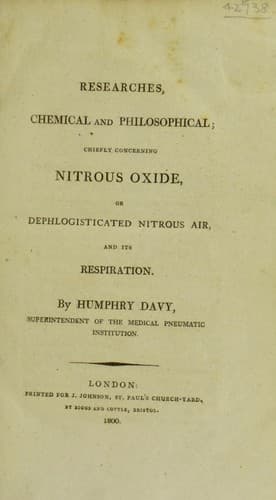
Researches Chemical and Philosophical; Chiefly concerning nitrous oxide: or dephlogisticated nitrous air and its respirationDavy, Humphry, Sir
Science
Researches Chemical and Philosophical; Chiefly concerning nitrous oxide: or dephlogisticated nitrous air and its respiration
Davy, Humphry, Sir
Nitrous oxide
_E._ 1. Temperature being 53°, 35 of nitrous oxide, mingled with 15 of
hydrocarbonate, were fired by the electric spark; the inflammation was
very vivid, and the light produced, bright red. After the explosion,
the space occupied by the gases equalled about 60. On the admission of
solution of strontian, a copious white precipitate was produced, and
the gas diminished by agitation, to rather more than 35. When 36 of
nitrous gas were added to these, white fumes appeared and the whole
diminished to 62. When a little muriatic acid was poured on the white
precipitate from the solution of strontian, gas was evolved from it,
and it was gradually dissolved.
_E._ 2. 22 nitrous oxide were inflamed with 20 hydrocarbonate; after
the explosion, they filled a space equal to 45; when strontian
lime water was introduced, white precipitation took place, and the
diminution was to 31.
To these 31, 14 of nitrous oxide were admitted, and the electric spark
passed through them; an inflammation took place: carbonic acid was
formed, after the absorption of which, the gas remaining filled a space
equal to 43, and did not diminish with nitrous gas.
The hydrocarbonate employed in these experiments, was procured from
alcohol by means of sulphuric acid. In another set of experiments made
with less accuracy, the same general results were obtained. Whenever
hydrocarbonate inflamed with nitrous oxide, both its constituents were
oxygenated; in all cases carbonic acid was formed, and in no instance
free hydrogene evolved, or charcoal precipitated.
In the decomposition of nitrous oxide by hydrocarbonate, the residual
nitrogene is less than in other combustions. This circumstance I am
unable to explain.
Reasoning from analogy, there can be little doubt, but that when
hydrocarbonate is inflamed with excess of nitrous oxide, it will be
only partially decompounded, or converted into nitrogene, nitrous acid,
and atmospheric air.
The Dutch Chemists have asserted, that charcoal does not burn in
nitrous oxide, except in consequence of the previous decomposition
of the gas by the hydrogene always contained in this substance; and
likewise, that when hydrocarbonate and nitrous oxide were mingled
together, and fired by the electric spark, the hydrogene only was
burnt, whilst the charcoal was precipitated.
It is difficult to account for these numerous mistakes. Their theory of
the _non-respirability_ of nitrous oxide was founded upon them. They
supposed that the chief use of respiration was to deprive the blood of
its superabundant carbon, by the combination of atmospheric oxygene
with that principle; and that nitrous oxide was highly fatal to life,
because it was incapable of de-carbonating the blood[178]!!
[178] Journal de Physique, xliii. 334.
X. _Combustion of Iron in Nitrous Oxide._
Public-domain text, read in full here on John Shaqi.
Reviews
Reviews
No reviews yet
Be the first to share your thoughts on this work.
Elsewhere in the archive
Join the Discussion
Join the discussion
Sign in to leave a comment or review.
Sign InorCreate an account