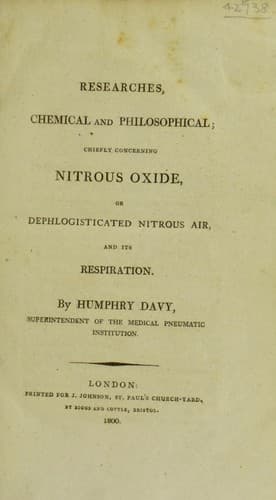
Researches Chemical and Philosophical; Chiefly concerning nitrous oxide: or dephlogisticated nitrous air and its respirationDavy, Humphry, Sir
Science
Researches Chemical and Philosophical; Chiefly concerning nitrous oxide: or dephlogisticated nitrous air and its respiration
Davy, Humphry, Sir
Nitrous oxide
I introduced into a jar of the capacity of 20 cubic inches, containing
11 cubic inches of nitrous oxide, over mercury, a small quantity of
fine iron wire twisted together, and having affixed to it a particle
of cork. On throwing the focus of a burning glass on the cork, it
instantly inflamed, and the fire was communicated to the wire, which
burnt with great vividness for some moments, projecting brilliant white
sparks. After it had ceased to burn the gas was increased in volume
rather more than three tenths of an inch. The nitrous acid tests were
introduced, but no acid appeared to have been formed. On exposing the
gas to water, near 4,2 cubic inches were absorbed: the 7,1 remaining
appeared to be pure nitrogene.
From this experiment it is evident that iron at the temperature of
ignition, is capable of decomposing nitrous oxide; likewise that it
is incapable of burning in it when it contains more than three fifths
nitrogene.
I attempted to inflame zinc in nitrous oxide, in the same way as iron;
but without success. By keeping the focus of a burning glass upon
some zinc filings, in a small quantity of nitrous oxide, I converted
a little of the zinc into white oxide, and consequently decomposed a
portion of the gas.
XI. _Combustion of Pyrophorus in Nitrous Oxide._
Pyrophorus, which inflames in nitrous gas, and atmospheric air, at or
even below 40°, requires for its combustion in nitrous oxide a much
higher temperature. It will not burn in it, or alter it, even at 212°.
I have often inflamed pyrophorus in nitrous oxide over mercury, by
means of a wire strongly heated, but not ignited. The light produced
by the ignition of pyrophorus in nitrous oxide is white, like that
produced by it in oxygene: in nitrous gas it is red.
When pyrophorus burns out in nitrous oxide, a little increase of the
volume of gas is produced. Strontian lime water agitated in this gas
becomes clouded; but the quantity of carbonic acid formed is extremely
minute. I have never made any delicate experiments on the combustion of
pyrophorus in nitrous oxide.
XII. _Combustion of the Taper in Nitrous Oxide._
It has been noticed by different experimentalists, that the taper burns
with a flame considerably enlarged in nitrous oxide: sometimes with a
vivid light and crackling noise, as in oxygene; at other times with a
white central flame, surrounded by a feeble blue one.
My experiments on the combustion of the taper in nitrous oxide, were
chiefly made with a view to ascertain the cause of the double flame.
When the inflamed taper is introduced into pure nitrous oxide, it burns
at first with a brilliant white light, and sparkles as in oxygene. As
the combustion goes on, the brilliancy of the flame diminishes; it
gradually lengthens, and becomes surrounded with a pale blue cone of
light, from the apex of which much unburnt charcoal is thrown off,
in the form of smoke. The flame continues double to the end of the
process.
Public-domain text, read in full here on John Shaqi.
Reviews
Reviews
No reviews yet
Be the first to share your thoughts on this work.
Elsewhere in the archive
Join the Discussion
Join the discussion
Sign in to leave a comment or review.
Sign InorCreate an account