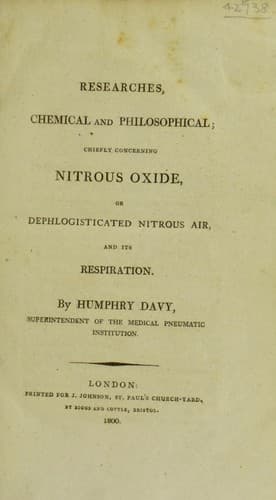
Researches Chemical and Philosophical; Chiefly concerning nitrous oxide: or dephlogisticated nitrous air and its respirationDavy, Humphry, Sir
Science
Researches Chemical and Philosophical; Chiefly concerning nitrous oxide: or dephlogisticated nitrous air and its respiration
Davy, Humphry, Sir
Nitrous oxide
When the residual gases are examined after combustion, much nitrous
acid is found suspended in them; and they are composed of carbonic
acid, nitrogene, and about one fourth of undecompounded nitrous oxide.
The double flame depends upon the nitrous acid formed by the ignition;
for it can be produced by plunging the taper into common air containing
nitrous acid vapor, or into a mixture of nitrous oxide and nitrogene,
through which nitrous acid has been diffused. It is never perceived in
the combustion of the taper, till much nitrous acid is formed.
In attempting to respire some residual gas of nitrous oxide, in which
a taper had burnt out, I found it so highly impregnated with nitrous
acid, as to disable me from even taking it into my mouth.
The taper burns in a mixture of equal parts nitrous oxide and
nitrogene, at first with a flame nearly the same as that of a candle in
common air; white. Before its extinction the interior white flame, and
exterior blue flame, are perceived.
The taper is instantly extinguished in a mixture of one fourth nitrous
oxide, and three fourths nitrogene.
In a mixture of equal parts nitrous oxide and nitrous gas, the taper
burns at first with nearly as much brilliancy as in pure nitrous oxide;
gradually the double and feeble flame is produced.
XIII. _On the Combustion of different Compound Bodies in Nitrous Oxide._
All the solid and fluid compound inflammable bodies on which I have
experimented, burn in nitrous oxide, at high temperatures. Wood,
cotton, and paper, are easily inflamed in it by the burning glass.
During their combustion, nitrous acid is always formed, carbonic acid,
and water produced, and nitrogene evolved, rather less in bulk than the
nitrous oxide decomposed.
I have already mentioned that alcohol and ether are soluble in nitrous
oxide. When an ignited body is introduced into the solution of
alcohol, or ether in nitrous oxide, a slight explosion takes place.
XIV. _General Conclusions relating to the Decomposition of Nitrous
Oxide, and to its Analysis._
From what has been said in the preceding sections, it appears that
the inflammable bodies, in general, require for their combustion in
nitrous oxide, much higher temperatures than those at which they burn
in atmospheric air, or oxygene.
When intensely heated they decompose it, with the production of much
heat and light, and become oxygenated.
During the combustion of solid or fluid bodies, producing flame, in
nitrous oxide, nitrous acid is generated, most probably from a new
arrangement of principles, analogous to those observed in Sect. II, by
the ignition of that part of the gas not in contact with the burning
substance. Likewise when nitrous oxide in excess is decomcomposed by
inflammable gases, nitrous acid, and sometimes a gas analogous to
common air, is produced, doubtless from the same cause.
Pyrophorus is the only body that inflames in nitrous oxide, below the
temperature of ignition.
Public-domain text, read in full here on John Shaqi.
Reviews
Reviews
No reviews yet
Be the first to share your thoughts on this work.
Elsewhere in the archive
Join the Discussion
Join the discussion
Sign in to leave a comment or review.
Sign InorCreate an account