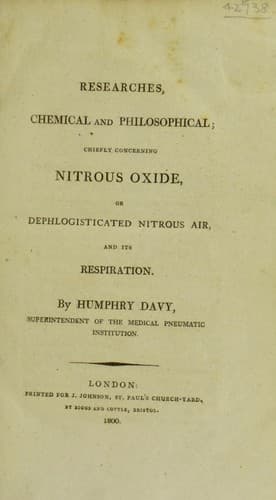
Researches Chemical and Philosophical; Chiefly concerning nitrous oxide: or dephlogisticated nitrous air and its respirationDavy, Humphry, Sir
Science
Researches Chemical and Philosophical; Chiefly concerning nitrous oxide: or dephlogisticated nitrous air and its respiration
Davy, Humphry, Sir
Nitrous oxide
Phosphorus burns in it with the blue flame, probably forming with its
oxygene only phosphoreous acid at the dull red heat, and with the
intensely vivid flame, producing phosphoric acid at the white heat.
Hydrogene, charcoal, sulphur, iron, and the compound inflammable
bodies, decompose it only at heats equal to, or above, that of
ignition: _probably_ each a different temperature.
From the phænomena in Sect. V. it appears, that at the temperature of
intense ignition, phosphorus has a stronger affinity for the oxygene
of nitrous oxide than hydrogene; and reasoning from the different
degrees of combustibility of the inflammable bodies, in mixtures of
nitrous oxide and nitrogene, and from other phænomena, we may conclude
with probability, that at about the white heat, the affinity of the
combustible bodies for oxygene takes place in the following order.
Phosphorus, hydrogene, charcoal,[179] iron, sulphur, &c.
This order of attraction is very different from that obtaining at the
red heat; in which temperature charcoal and iron have a much stronger
affinity for oxygene than either phosphorus or hydrogene.[180]
[179] As is proved by the decomposition of oxide of iron and sulphuric
acid by charcoal, at that temperature.
[180] Hydrogene at or about the red heat, appears to attract oxygene
stronger than phosphorus. See Dr. Priestley’s experiments, vol. i. page
262.
The smallest quantity of oxygene given in the different analyses of
nitrous oxide just detailed, is thirty five hundred parts; the greatest
proportion is thirty-nine.
Taking the mean estimations from the most accurate experiments, we may
conclude that 100 grains of the known ponderable matter of nitrous
oxide, consist of about 36,7 oxygene, and 63,3 nitrogene; or taking
away decimals, of 37 oxygene to 63 nitrogene; which is identical with
the estimation given in Research I.
XV. _Observations on the combinations of Oxygene and Nitrogene._
During the decompositions of the combinations of oxygene and nitrogene
by combustible bodies, a considerable momentary expansion of the acting
substances, and the bodies in contact with them is generally produced,
connected with increased temperature; whilst light is often generated
to a great extent.
Of the causes of these phænomena we are at present ignorant. Our
knowledge of them must depend upon the discovery of the precise nature
of heat and light, and of the laws by which they are governed. The
application of general hypotheses to isolated facts can be of little
utility; for this reason I shall at present forbear to enter into any
discussions concerning those agents, which are imperceptible to the
senses, and known only by solitary effects.
Analysis and synthesis clearly prove that oxygene and nitrogene
constitute the known ponderable matter of atmospheric air, nitrous
oxide, nitrous gas, and nitric acid.
That the oxygene and nitrogene of atmospheric air exist in chemical
union, appears almost demonstrable from the following evidences.
Public-domain text, read in full here on John Shaqi.
Reviews
Reviews
No reviews yet
Be the first to share your thoughts on this work.
Elsewhere in the archive
Join the Discussion
Join the discussion
Sign in to leave a comment or review.
Sign InorCreate an account