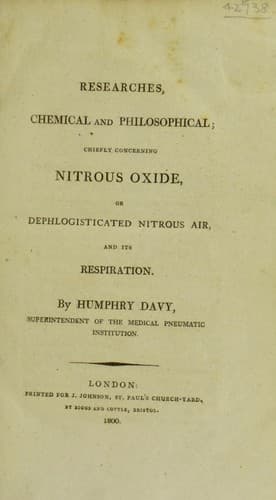
Researches Chemical and Philosophical; Chiefly concerning nitrous oxide: or dephlogisticated nitrous air and its respirationDavy, Humphry, Sir
Science
Researches Chemical and Philosophical; Chiefly concerning nitrous oxide: or dephlogisticated nitrous air and its respiration
Davy, Humphry, Sir
Nitrous oxide
1st. The equable diffusion of oxygene and nitrogene through every part
of the atmosphere, which can hardly be supposed to depend on any other
cause than an affinity between these principles.[181]
[181] That attraction must be called chemical, which enables bodies of
different specific gravities to unite in such a manner as to produce a
compound, in every part of which the constituents are found in the same
proportions to each other. Atmospheric air, examined after having been
at perfect rest in closed vessels, for a great length of time, contains
in every part the same proportions of oxygene and nitrogene; whereas
if no affinity existed between these principles, following the laws
of specific gravity, they ought to separate; the oxygene forming the
inferior, the nitrogene the superior stratum.
The supposition of the _chemical_ composition of atmospheric air, has
been advanced by many philosophers. The two first evidences have been
often noticed.
2dly. The difference between the specific gravity of atmospheric
air, and a mixture of 27 parts oxygene and 73 nitrogene, as found by
calculation; a difference apparently owing to expansion in consequence
of combination.
3dly. The conversion of nitrous oxide into nitrous acid, and a gas
analogous to common air, by ignition.
4thly. The solubility of atmospheric air undecompounded in water.
ATMOSPHERIC AIR, then, may be considered as the least intimate of the
combinations of nitrogene and oxygene.
It is an elastic fluid, permanent at all known temperatures, consisting
of,73 nitrogene, and,27 oxygene. It is decomposable at certain
temperatures, by most of the bodies possessing affinity for oxygene. It
is soluble in about thirty times its bulk of water, and as far as we
are acquainted with its affinities, incapable of combining with most of
the simple and compound substances. 100 cubic inches of it weigh about
31 grains at 55° temperature, and 30 atmospheric pressure.
NITROUS OXIDE is a gas unalterable in its constitution, at temperatures
below ignition. It is composed of oxygene and nitrogene, existing
_perhaps_ in the most intimate union which those substances are capable
of assuming.[182] Its properties approach to those of acids. It is
decomposable by the combustible bodies at very high temperatures, is
soluble in double its volume of water, and in half its bulk of most of
the inflammable fluids. It is combinable with the alkalies, and capable
of forming with them peculiar salts. 100 grains of it are composed of
about 63 nitrogene, and 37 oxygene. 100 cubic inches of it weigh 50
grains, at 55° temperature, and 30 atmospheric pressure.
[182] For it is unalterable by those bodies which are capable of
attracting oxygene from nitrous gas and nitrous acid, at common
temperatures.
Public-domain text, read in full here on John Shaqi.
Reviews
Reviews
No reviews yet
Be the first to share your thoughts on this work.
Elsewhere in the archive
Join the Discussion
Join the discussion
Sign in to leave a comment or review.
Sign InorCreate an account