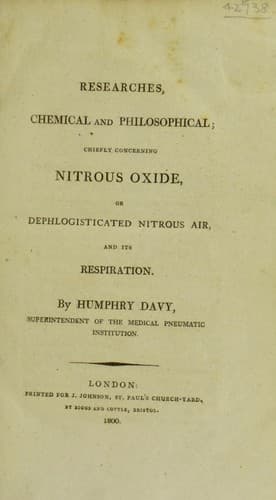
Researches Chemical and Philosophical; Chiefly concerning nitrous oxide: or dephlogisticated nitrous air and its respirationDavy, Humphry, Sir
Science
Researches Chemical and Philosophical; Chiefly concerning nitrous oxide: or dephlogisticated nitrous air and its respiration
Davy, Humphry, Sir
Nitrous oxide
The communication was now made between the globe and the mercurial
airholder containing oxygene. 64 cubic inches were slowly pressed in,
when the outside of the globe became warmer, and the color on the
inside changed to a very dark orange. As it cooled, 6 cubic inches more
slowly entered; but no new increase of temperature, or change of color
took place.
The globe being now completely cold, was stopped, removed, and
weighed; it had gained 24,5 grains, from whence it appears that 0,4
grains of common air contained in the stop-cocks, had entered with the
oxygene.[20]
[20] I judged it expedient always to ascertain the quantity of air in
the stop-cocks by weight, as it was impossible to join them so as to
have always an equal capacity. The upper tubes of the two stop-cocks
not joined, contained nearly an inch and half.
To absorb the nitrous acid gas, 41 grains of water were introduced by
the tube of the stop-cock, which though closed as rapidly as possible,
must have suffered nearly,5 grains of air to enter at the same time, as
the increase of weight was 41,5 grains. The dark orange of the globe
diminished rapidly; it became warm at the bottom, and moist on the
sides. After a few minutes the color had almost wholly disappeared.
To ascertain the quantity of aëriform fluid absorbed, the globe was
again attached to the mercurial air apparatus, containing 140 cubic
inches of common air. When the communication was made, 51 cubic inches
rushed in, and it gained in weight 16,5 grains.
A quantity of fluid equal to 54 grains was now taken out of the globe.
On examination it proved to be slightly tinged with green, and occupied
a space equal to that filled by 41,5 grains of water. Its specific
gravity was consequently 1,301.
To ascertain if any unabsorbed aëriform nitrous acid remained in the
globe, 13 grains of solution of ammonia were introduced in the same
manner as the water, and after some minutes, when the white vapor
had condensed, the communication was again made with the mercurial
airholder containing common air. A minute quantity entered, which could
not be estimated at more than three fourths of an inch, and the globe
was increased in weight about 13,25 grains.[21]
Common air was now thrown into the globe till the residual gases of
the experiment were judged to be displaced; it weighed 2106,5 grains,
that is, 40 grains more than it had weighed when filled with common air
before the experiment.[22]
[21] That is, by the solution of ammonia, and air.
[22] The following is an account of the increase and diminution of
weight of the globe, as it was noted in the journal.
Public-domain text, read in full here on John Shaqi.
Reviews
Reviews
No reviews yet
Be the first to share your thoughts on this work.
Join the Discussion
Join the discussion
Sign in to leave a comment or review.
Sign InorCreate an account