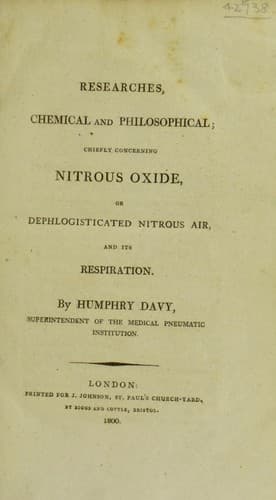
Researches Chemical and Philosophical; Chiefly concerning nitrous oxide: or dephlogisticated nitrous air and its respirationDavy, Humphry, Sir
Science
Researches Chemical and Philosophical; Chiefly concerning nitrous oxide: or dephlogisticated nitrous air and its respiration
Davy, Humphry, Sir
Nitrous oxide
In comparing my results with those of Lavoisier and Kirwan, the
estimation of the weights of nitrogene and oxygene is very little
different, the corrections for temperature and pressure being made,
from that of those celebrated philosophers. The first makes oxygene to
weigh[15] 34,21, and nitrogene 30,064 per cent; and the last, oxygene
34,[16] and nitrogene 30,5.
[13] A table of the specific gravities of these gases, and other gases,
hereafter to be mentioned, reduced to a barometrical and thermometrical
standard, will be given in the appendix.
[14] 40 measures, exposed to solution of potash, gave an absorption of
not quite a quarter of a measure: hence it contained an inconsiderable
quantity of carbonic acid.
[15] Traité Elementaire.
[16] Essai sur le phlogistique, page 30.
The specific gravity of nitrous gas, according to Kirwan, is to that of
common air as 1194 to 1000. Hence it should weigh about 37 grains per
cent. This difference from my estimation is not nearly so great as I
expected to have found it.[17]
IV.[18] The thermometer in the laboratory standing at 55°, and the
barometer at 30,1, I now proceeded to my experiment. The oxygene that
I employed was of the same composition as that which I had previously
weighed. The nitrous gas contained,0166 nitrogene.
For the purpose of combining the gases, a glass balloon was procured,
of the capacity of 148 cubic inches, with a glass stop-cock adapted to
it, having its upper orifice tubulated and graduated for the purpose of
containing and measuring a fluid. The whole weight of this globe and
its appendages, when filled with common air, was 2066,5 grains.
[17] The diminution of the specific gravity of the gas from the
quantity of nitrogene evolved in his experiment, probably destroyed, in
some measure, the source of error from the nitrous acid carried over.
[18] Experiment I.
It was partially exhausted by the air-pump, and lost in weight just
32 grains. From whence we may conclude that about 15 grains of air
remained in it.
In this state of exhaustion it was immediately cemented to the
stop-cock of the mercurial airholder, and the communication being made
with great caution, 82 cubic inches of nitrous gas rushed into the
globe, on the outside of which a slight increase of temperature was
perceived, while the gases on the inside appeared of a deep orange.
Before the common temperature was restored, the communication was
stopped, and the globe removed. The increase of weight was 29,25
grains; whence it appeared that 1,14 grains of common air, part of
which had been contained in the stop-cocks, had entered with the
nitrous gas.
Whilst it was cooling, from the accidental loosening of the stopper of
the cock, 3 grains more of common air entered.[19]
[19] That no greater contraction took place depended on the solution
of the nitrous acid formed in the nitrous gas; a phænomenon to be
explained hereafter.
Public-domain text, read in full here on John Shaqi.
Reviews
Reviews
No reviews yet
Be the first to share your thoughts on this work.
Join the Discussion
Join the discussion
Sign in to leave a comment or review.
Sign InorCreate an account