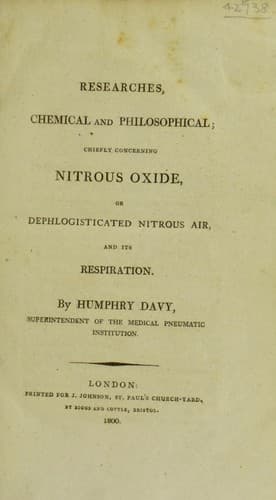
Researches Chemical and Philosophical; Chiefly concerning nitrous oxide: or dephlogisticated nitrous air and its respirationDavy, Humphry, Sir
Science
Researches Chemical and Philosophical; Chiefly concerning nitrous oxide: or dephlogisticated nitrous air and its respiration
Davy, Humphry, Sir
Nitrous oxide
_c._ Of two thornbacks, one, C was introduced into about an ounce of
boiled water in contact with hydrogene, standing over mercury. The
other, D, was introduced into well boiled water saturated with nitrous
oxide, and standing in contact with it over mercury. C lived near
thirteen minutes, and died without being previously much agitated. D
was apparently motionless, after having the same affections as A in the
last experiment, in sixteen minutes. At the end of this time he was
taken out and introduced into common water. He soon began to move his
gills, and in less than a quarter of an hour was so far recovered as to
be able to swim.
The last experiment was repeated on two smaller thornbacks; that in the
aqueous solution of nitrous oxide lived near seventeen minutes, that in
the water in contact with hydrogene, about fifteen and half.
The experiments in Res. I. Div. 3, prove the difficulty, and indeed
almost impossibility of driving from water by boiling, the whole of the
atmospheric air held in solution by it; they likewise show that nitrous
oxide by its strong affinity for water, is capable of expelling air
from that fluid after no more can be procured from it by ebullition.
Hence, if water saturated with nitrous oxide had no positive effects
upon fishes; they ought to die in it much sooner than in water deprived
of air by ebullition. From their living in it rather longer;[189] we
may conclude, that they are destroyed not by privation of atmospheric
air, but from some positive change effected in their blood by the gas.
[189] A priori I expected that fishes, like amphibious animals would
have been very quickly destroyed by the action of nitrous oxide.
A long while ago, from observing that the gills of fish became rather
of a lighter red during their death, in the atmosphere; I conjectured
that the disease of which they died, was probably hyperoxygenation
of the blood connected with highly increased animal heat. For not
only is oxygene presented to their blood in much larger quantities in
atmospheric air than in its aqueous solution; but likewise, to use
common language, in a state in which it contains much more _latent
heat_. Without however laying any stress on this supposition, I had the
curiosity to try whether thornbacks would live longest in atmospheric
air or nitrous oxide. In one experiment, they appeared to die in them
nearly in the same time. In another, the fish in nitrous oxide lived
nearly half as long again as that in atmospheric air.
IX. _Effects of Nitrous Oxide on Insects._
The winged insects furnished with breathing holes, become motionless
in nitrous oxide very speedily; being however possessed of a certain
voluntary power over respiration, they sometimes recover, after having
been exposed to it for some minutes, under the action of atmospheric
air.
Public-domain text, read in full here on John Shaqi.
Reviews
Reviews
No reviews yet
Be the first to share your thoughts on this work.
Elsewhere in the archive
Join the Discussion
Join the discussion
Sign in to leave a comment or review.
Sign InorCreate an account