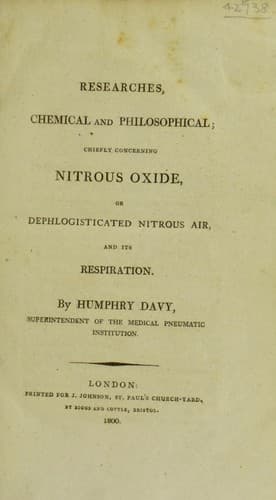
Researches Chemical and Philosophical; Chiefly concerning nitrous oxide: or dephlogisticated nitrous air and its respirationDavy, Humphry, Sir
Science
Researches Chemical and Philosophical; Chiefly concerning nitrous oxide: or dephlogisticated nitrous air and its respiration
Davy, Humphry, Sir
Nitrous oxide
A butterfly was introduced into a small jar, filled with pure nitrous
oxide, over mercury, He struggled a little during the first two or
three seconds; in about seven seconds, his legs became convulsed, and
his wings were wrapt round his body; in about half a minute he was
senseless; taken out after six minutes, he did not recover.
Another butterfly introduced into hydrogene, became convulsed in about
a quarter of a minute, was senseless in twenty seconds, and taken out
after five minutes, did not revive.
A large drone, after being in nitrous oxide for a minute and a quarter,
was taken out senseless. After being for some time exposed to the
atmosphere, he began to move, and at last rose on his wings. For some
time, however, he was unable to fly in a straight line; and often
after describing circles in the air, fell to the ground as if giddy.
A large fly, became motionless in nitrous oxide after being convulsed,
in about half a minute. Another was rendered senseless in hydrogene, in
less than a quarter of a minute.
A fly introduced into hydrocarbonate, dropt immediately senseless;
taken out after about a quarter of a minute, he recovered; but like the
fly that had lived after exposure to nitrous oxide, was for some time
vertiginous.
Flies live much longer under water, alcohol, or oil, than in
non-respirable gases, or gases incapable of supporting life. A certain
quantity of air always continues attached in the fluid to the fine
hairs surrounding their breathing holes, sufficient to support life for
a short time.
Snails and earth-worms, live in nitrous oxide a long while, they die in
it however, much sooner than in water or hydrogene; probably from the
same causes as the amphibious animals.
DIVISION II.
_Of the CHANGES effected in NITROUS OXIDE, and other
GASES, by the RESPIRATION of ANIMALS._
I. _Preliminaries._
As soon as I had discovered that nitrous oxide was respirable, and
possessed of extraordinary powers of action on living beings, I was
anxious to be acquainted with the changes effected in it by the venous
blood. To investigate these changes, appeared at first a simple
problem; I soon however found that it involved much preliminary
knowledge of the chemical properties and affinities of nitrous oxide.
After I had ascertained by experiments detailed in the preceding
Researches, the composition of this gas its combinations, and the
physical changes effected by it in living beings, I began my enquiry
relating to the mode of its operation.
Finding that the residual gas of nitrous oxide after it had been
breathed for some time in silk bags, was chiefly nitrogene, I at first
conjectured that nitrous oxide was decomposed in respiration in the
same manner as atmospheric air, and its oxygene only combined with the
venous blood; the following experiments soon however convinced me of my
error.
II. _Absorption of Nitrous Oxide by venous blood. Changes effected in
the blood by different Gases._
Public-domain text, read in full here on John Shaqi.
Reviews
Reviews
No reviews yet
Be the first to share your thoughts on this work.
Elsewhere in the archive
Join the Discussion
Join the discussion
Sign in to leave a comment or review.
Sign InorCreate an account