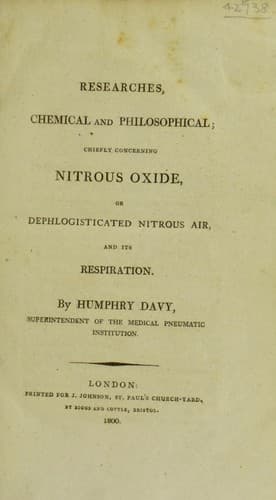
Researches Chemical and Philosophical; Chiefly concerning nitrous oxide: or dephlogisticated nitrous air and its respirationDavy, Humphry, Sir
Science
Researches Chemical and Philosophical; Chiefly concerning nitrous oxide: or dephlogisticated nitrous air and its respiration
Davy, Humphry, Sir
Nitrous oxide
_a._ Though the laws of the coagulability of the blood are unknown,
yet we are certain that at the moment of coagulation, a perfectly new
arrangement of its principles takes place; consequently, their powers
of combination must be newly modified. The affinities of living blood
can only be ascertained during its circulation in the vessels of
animals. At the moment of effusion from those vessels, it begins to
pass through a series of changes, which first produce coagulation, and
finally its compleat decomposition.
Consequently, the action of fluid blood upon gates out of the vessels,
will be more analogous to that of circulating blood in proportion as it
is more speedily placed in contact with them.
_b._ To ascertain the changes effected in nitrous oxide by fluid venous
blood.
A jar, six inches long and half an inch wide, graduated to,05 cubic
inches, having a tight stopper adapted to it, was filled with
nitrogene, which is a gas incapable of combining with, and possessing
no power of a action upon venous blood. A large orifice was made in the
vein of a tolerably healthy man, and the stopper removed from the jar,
which was brought in contact with the arm so as to receive the blood,
and pressed close against the skin, in such a way as to leave an
orifice just sufficient for the escape of the nitrogene, as the blood
flowed in. When the jar was full, it was closed, and carried to the
pneumatic apparatus, the mercury of which had been previously a little
warmed. A small quantity of the blood was transferred into another
jar to make room for the gas. The remaining quantity equalled exactly
two cubic inches; to this was introduced as speedily as possible,
eleven measures equal to,55 cubic inches of nitrous oxide, which
left a residuum of ¹/₃₂ only, when absorbed by boiled water, and was
consequently, perfectly pure. On agitation, a rapid diminution of the
gas took place.
In the mass of blood which was opaque, but little change of color could
be perceived; but that portion of it diffused over the sides of the
jar, was evidently of a brighter purple than the venous blood.
It was agitated for two or three minutes, and then suffered to rest; in
eight minutes it had wholly coagulated; a small quantity of serum had
separated, and was diffused over the coagulum. This coagulum was dark;
but evidently of a more purple tinge than that of venous blood; no gas
had apparently been liberated during its formation.
The nitrous oxide remaining, was not quite equal to seven measures;
hence, at least four measures of it had been absorbed.
Public-domain text, read in full here on John Shaqi.
Reviews
Reviews
No reviews yet
Be the first to share your thoughts on this work.
Elsewhere in the archive
Join the Discussion
Join the discussion
Sign in to leave a comment or review.
Sign InorCreate an account