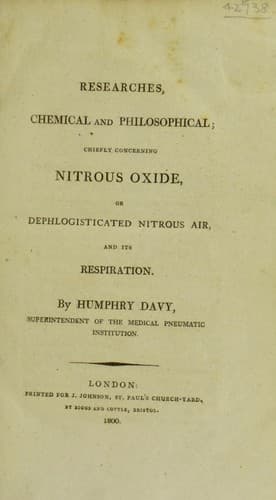
Researches Chemical and Philosophical; Chiefly concerning nitrous oxide: or dephlogisticated nitrous air and its respirationDavy, Humphry, Sir
Science
Researches Chemical and Philosophical; Chiefly concerning nitrous oxide: or dephlogisticated nitrous air and its respiration
Davy, Humphry, Sir
Nitrous oxide
To ascertain the nature of the residuum, it was necessary to transfer
it into another vessel, but this I found very difficult to accomplish,
on account of the coagulated blood. By piercing through the coagulum
and removing part of it by means of curved iron forceps, I at last
contrived to introduce about 4½ measures of the gas into a small
cylinder, graduated to,25 cubic inches, in which it occupied of course,
nearly 9 measures; when a little solution of strontian was admitted to
these, it became very slightly clouded; but the absorption that took
place did not more than equal half its bulk. Consequently, the quantity
of carbonic acid evolved from the blood, or formed, must have been
extremely minute.
On the introduction of pure water, a rapid absorption of the gas took
place, and after agitation, not quite 3 measures remained. These did
not _perceptibly_ diminish with nitrous gas; their quantity was too
small to be examined by any other test; but there is reason to suppose
that they were chiefly composed of nitrogene.
From this experiment, it appeared that nitrous oxide is absorbed when
placed in contact with venous blood; at the same time, that a very
minute quantity of carbonic acid and probably nitrogene is produced.
_c._ In another similar experiment when nearly half a cubic inch of
nitrous oxide was absorbed by about a cubic inch and three quarters of
fluid blood, the residual gas did not equal more than ⅛, the quantity
absorbed being taken as unity. This fact induced me to suppose that
the absorption of nitrous oxide by venous blood, was owing to a simple
solution of the gas in that fluid, analogous to its solution in water
or alcohol.
To ascertain if nitrous oxide could be expelled from blood impregnated
with it, by heat; I introduced to 2 cubic inches of fluid blood taken
from the medial vein, about,6 cubic inches of nitrous oxide. After
agitation, in seven minutes nearly,4 were absorbed. In ten minutes,
after the blood had completely coagulated, the cylinder containing it,
was transferred in contact with mercury, into a vessel of solution of
salt in water; this solution was heated and made to boil. During its
ebullition, the whole of the blood became either white or pale brown,
and formed a solid coherent mass; whilst small globules of gas were
given out from it. In a few minutes, about,25 of gas had collected.
After the vessel had cooled, I attempted to transfer this gas into
a small graduated jar in the mercurial apparatus, but in vain; the
mass in the jar was so solid and tough, that I could not remove it.
By transferring it to the water apparatus, I succeeded in displacing
enough of the coagulum to suffer the water to come in contact with
the gas; an absorption of nearly half of it took place; hence, _I
conjecture_, that nitrous oxide had been given out by the impregnated
blood.
Public-domain text, read in full here on John Shaqi.
Reviews
Reviews
No reviews yet
Be the first to share your thoughts on this work.
Elsewhere in the archive
Join the Discussion
Join the discussion
Sign in to leave a comment or review.
Sign InorCreate an account