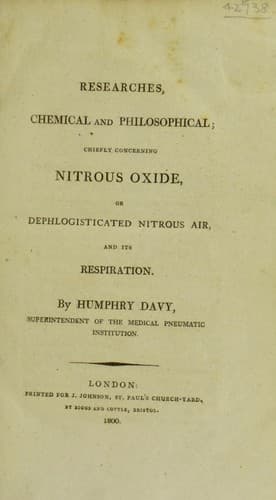
Researches Chemical and Philosophical; Chiefly concerning nitrous oxide: or dephlogisticated nitrous air and its respirationDavy, Humphry, Sir
Science
Researches Chemical and Philosophical; Chiefly concerning nitrous oxide: or dephlogisticated nitrous air and its respiration
Davy, Humphry, Sir
Nitrous oxide
_d_. Some fresh dark coagulum of venous blood, was exposed to nitrous
oxide. A very slight alteration of color took place at the surface of
the blood, perceptible only in a strong light, and a minute quantity of
gas was absorbed. A taper burnt in the remaining gas as brilliantly as
before, hence, it had apparently suffered no alteration.
_e_. To compare the physical changes effected in the venous blood
by nitrous oxide, with those produced by other gases, I made the
following experiments.—I filled a large phial, containing near 14 cubic
inches, with blood from the vein of the arm of a man, and immediately
transferred it to the mercurial apparatus. Different portions of it
were thrown into small graduated cylinders, filled with the following
gases: nitrogene, nitrous gas, common air, oxygene, nitrous oxide,
carbonic acid, and hydrocarbonate.
The blood in each of them was successively agitated till it began
to coagulate; and making allowances for the different periods of
agitation, there was no marked difference in the times of coagulation.
The color of the coagulum in every part of the cylinder, containing
nitrogene, was the same very dark red. When it was agitated so as to
tinge the sides of the jar, it appeared exactly of the color of venous
blood received between two surfaces of glass; no perceptible absorption
of the gas had taken place.
The blood in nitrous gas was dark, and much more purple on the top than
that in nitrogene. When agitated so as to adhere to the jar as a thin
surface, this purple was evidently deep and bright. An absorption of
rather more than ⅛ of the volume of gas had taken place.
The blood in oxygene and atmospheric air, were of a much brighter
tinge than that in any of the other gases. On the top, the color was
vermilion, but no perceptible absorption had taken place.
The coagulum in nitrous oxide, when examined in the mass was dark,
and hardly distinguishable in its color from venous blood; but when
minutely noticed at the surface where it was covered with serum, and in
its diffusion over the sides of the jar, it appeared of a fine purple
red, a tinge brighter than the blood in nitrous gas. An absorption had
taken place in this cylinder, more considerable than in any of the
others.
In carbonic acid, the coagulum was of a brown red, much darker than the
venous blood, and a slight diminution of gas had taken place.
In the hydrocarbonate,[190] the blood was red, a shade darker than the
oxygenated blood, and a very slight diminution of the gas[191] was
perceptible.
[190] The hydrocarbonate employed, was procured from alcohol, by means
of sulphuric acid. This gas contains more carbon, than hydrocarbonate
from water and charcoal.
[191] The curious fact of the reddening of venous blood by
hydrocarbonate, was discovered by Dr. Beddoes.
Public-domain text, read in full here on John Shaqi.
Reviews
Reviews
No reviews yet
Be the first to share your thoughts on this work.
Elsewhere in the archive
Join the Discussion
Join the discussion
Sign in to leave a comment or review.
Sign InorCreate an account