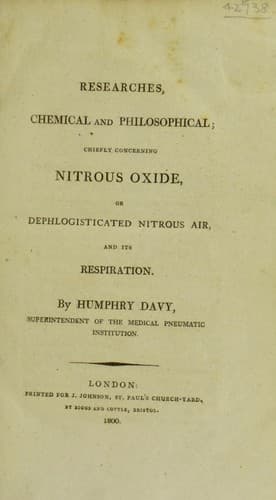
Researches Chemical and Philosophical; Chiefly concerning nitrous oxide: or dephlogisticated nitrous air and its respirationDavy, Humphry, Sir
Science
Researches Chemical and Philosophical; Chiefly concerning nitrous oxide: or dephlogisticated nitrous air and its respiration
Davy, Humphry, Sir
Nitrous oxide
_f._ To human blood that had been saturated with nitrous oxide whilst
warm and constantly agitated for four or five minutes, to prevent its
uniform coagulation, oxygene was introduced; the red purple on the
surface of it, immediately changed to vermilion; and on agitation,
this color was diffused through it. On comparing the tinge with that
of oxygenated blood, no perceptible difference could be observed.
No change of volume of the oxygene introduced, had taken place; and
consequently, no nitrous oxide had been evolved from the blood.
_g._ Blood, impregnated with nitrous gas, was exposed to oxygene; but
after agitation in it for many minutes, no change of its dark purple
tinge could be observed, though a slight diminution of the oxygene
appeared to take place.
_h._ Blood that had been rendered vermilion in every part by long
agitation in atmospheric air, the coagulum of which was broken and
diffused with the coagulable lymph through the serum, was exposed to
nitrous oxide; for some minutes no perceptible change of color took
place; but by agitation for two or three hours, it evidently affirmed a
purple tinge, whilst a a slight absorption of gas took place. It never
however, became nearly so dark as venous blood that had been exposed to
nitrous oxide.
_i._ Blood, oxygenated in the same manner as in the last experiment,
the coagulum of which had been broken, was exposed to nitrous gas. The
surface of it immediately became purple, and by agitation for a few
minutes, this color was diffused through it. A slight diminution of the
gas was observed. On comparing the tinge with that of venous blood that
had been previously exposed to nitrous gas, there was no perceptible
difference.
_k._ Blood exposed to oxygenated muriatic acid is wholly altered in its
constitution and physical properties, as has been often noticed; the
coagulum becomes black in some parts, and brown and white in others.
Venous blood, after agitation in hydrogene or nitrogene, oxygenates
when exposed to the atmosphere in the same manner as simple venous
blood. I had the curiosity to try whether venous blood exposed to
hydrogene, would retain its power of being oxygenated longer than
blood saturated with nitrous oxide: for this purpose some similar black
coagulum was agitated for some time in two phials, one filled with
hydrogene, the other with nitrous oxide. They were then suffered to
rest for three days at a temperature from about 56° to 63°. After being
opened, no offensive smell was perceived in either of them, the blood
in hydrogene was rather darker than at the time of their exposure,
whilst that in nitrous oxide was of a brighter purple. On being
agitated for some time in the atmosphere, the blood in nitrous oxide
became red, but not of so bright a tinge as oxygenated venous blood.
The color of the blood in hydrogene did not at all alter.
Public-domain text, read in full here on John Shaqi.
Reviews
Reviews
No reviews yet
Be the first to share your thoughts on this work.
Elsewhere in the archive
Join the Discussion
Join the discussion
Sign in to leave a comment or review.
Sign InorCreate an account