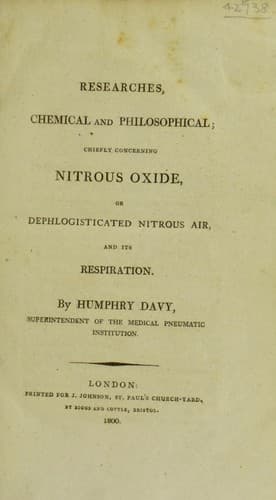
Researches Chemical and Philosophical; Chiefly concerning nitrous oxide: or dephlogisticated nitrous air and its respirationDavy, Humphry, Sir
Science
Researches Chemical and Philosophical; Chiefly concerning nitrous oxide: or dephlogisticated nitrous air and its respiration
Davy, Humphry, Sir
Nitrous oxide
Though experiments on successive inspirations of pure nitrous oxide
might go far to determine whether or no any nitrogene, carbonic acid
and oxygene were products of respiration, yet I distinctly saw that it
was impossible in this way to ascertain their quantities, supposing
them produced, unless I could first determine the capacity of my lungs;
and the different proportions of the gases remaining in the bronchial
vessels after a compleat expiration, when atmospheric air had been
respired.
In some experiments (that I made on the respiration of hydrogene,
with a view to determine whether carbonic acid was _produced_ by
the combination of carbon loosely combined in the venous blood,
with the oxygene respired, or whether it was simply _given out_ as
excrementitious by this blood) I found, without however being able to
solve the problem I had proposed to myself, that in the respiration of
pure hydrogene, little or no alteration of volume took place; and that
the residual gas was mingled with some nitrogene, and a little oxygene
and carbonic acid.
From the comparison of these facts with those noticed in the last
section and in R. III. Div. I. there was every reason to suppose
that hydrogene was not absorbed or altered when respired: but only
mingled with the residual gases of the lungs. Hence, by making a full
expiration of atmospheric air, and afterwards taking six or seven
respirations of hydrogene in the mercurial airholder, and then making
a compleat expiration, I conjectured that the residual gas and the
hydrogene would be so mingled, as that nearly the same proportions
should remain in the bronchial vessels, as in the airholder. By
ascertaining these proportions and calculating from them, I hoped to be
able to ascertain with tolerable exactness, the capacity of my fauces
and bronchia, as well as the composition of the gas remaining in them,
after a complete expiration of common air.
IV. _Respiration of Hydrogene._
The hydrogene that I employed, was procured from the decomposition of
water by means of clean iron filings and diluted sulphuric and muriatic
acids. It was breathed in the same manner as nitrous oxide, in the
large mercurial airholder.
After a compleat voluntary exhaustion of my lungs in the usual
posture, I found great difficulty in breathing hydrogene for so
long as half a minute, so as to make a compleat expiration of it. It
produced uneasy feelings in the chest, momentary loss of muscular
power, and sometimes a transient giddiness.
In some of the experiments that I made; on account of the giddiness,
the results were rendered inconclusive, by my removing my mouth from
the mouth-piece after expiration, before the assistant could turn the
stop-cock.
Public-domain text, read in full here on John Shaqi.
Reviews
Reviews
No reviews yet
Be the first to share your thoughts on this work.
Elsewhere in the archive
Join the Discussion
Join the discussion
Sign in to leave a comment or review.
Sign InorCreate an account