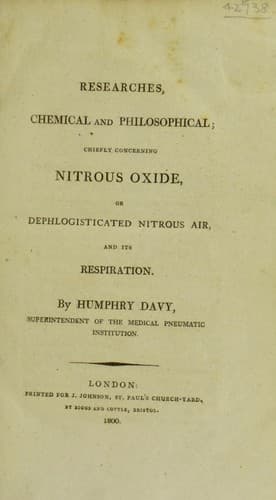
Researches Chemical and Philosophical; Chiefly concerning nitrous oxide: or dephlogisticated nitrous air and its respirationDavy, Humphry, Sir
Science
Researches Chemical and Philosophical; Chiefly concerning nitrous oxide: or dephlogisticated nitrous air and its respiration
Davy, Humphry, Sir
Nitrous oxide
The purity of the hydrogene was ascertained immediately before the
experiment by the test of nitrous gas, and by detonation with oxygene
or atmospheric air; generally 12 measures of atmospheric air were fired
with 4 of the hydrogene, and if the diminution was to ten or a little
more, the gas was judged to be pure.
After the experiment, when the compleat expiration had been made and
the common temperature restored; the volume of the gas was noticed,
and then a small quantity of it thrown into the mercurial apparatus by
means of the conducting tube, to be examined. The carbonic acid was
separated by from it by means of solution of potash or strontian; the
quantity of oxygene it contained, was ascertained by means of nitrous
gas of known composition; the superabundant nitrous gas was absorbed
by solution of muriate of iron; and the proportions of hydrogene
and nitrogene in the remaining gas, discovered by inflammation with
atmospheric air or oxygene in the detonating tube by the electric spark.
_a._ The two following experiments made upon quantities of hydrogene,
equal to those of the nitrous oxide respired in the experiments in the
last section, are given as the most accurate of five.
E. 1. I respired at 59° 102 cubic inches of hydrogene apparently pure,
for rather less than half a minute, making in this time seven quick
respirations.
After the complete expiration, when the common temperature was
restored, the gas occupied a space equal to 103 cubic inches nearly.
These analised were found to consist of
Carbonic acid 4,0
Oxygene 3,7
Nitrogene 17,3
Hydrogene 78,0
—————
103,0
Now as in this experiment, the gas was increased in bulk only a cubic
inch; supposing that after the compleat expiration the gas in the
lungs, bronchia and fauces was of nearly similar composition with
that in the airholder, and that no hydrogene had been absorbed by the
blood, it would follow that 24 cubic inches of hydrogene remained in
the internal organs of respiration, and consequently, by the rule of
proportion, about 7,8 of the mixed residual gas of the common air.
And then the whole quantity of residual gas of the lungs, supposing
the temperature 59°, would have been 31,8 cubic inches; but as its
temperature was nearly that of the internal parts of the body, 98°, it
must have filled a greater space; calculating from the experiments of
Guyton and Vernois,[194] about 37,5[195] cubic inches.
Public-domain text, read in full here on John Shaqi.
Reviews
Reviews
No reviews yet
Be the first to share your thoughts on this work.
Elsewhere in the archive
Join the Discussion
Join the discussion
Sign in to leave a comment or review.
Sign InorCreate an account