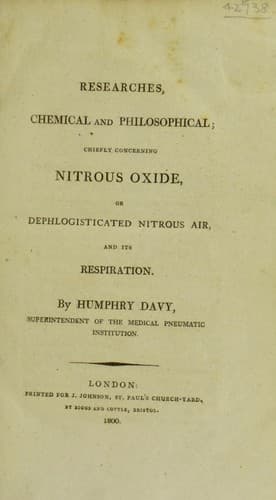
Researches Chemical and Philosophical; Chiefly concerning nitrous oxide: or dephlogisticated nitrous air and its respirationDavy, Humphry, Sir
Science
Researches Chemical and Philosophical; Chiefly concerning nitrous oxide: or dephlogisticated nitrous air and its respiration
Davy, Humphry, Sir
Nitrous oxide
From the increase of volume, it would appear that a minute quantity
of gas had been generated during the respiration, and this was, as we
shall see hereafter, most probably carbonic acid.[196] Likewise there
is reason to suppose, that a little of the residual oxygene must have
been absorbed. Making allowances for those circumstances, it would
follow, that the 37,5 cubic inches of gas remaining in my lungs, after
a compleat expiration of atmospheric air at animal heat 98°, equal to
31,8 cubic inches at 59°, were composed of
Nitrogene 21,9
Carbonic acid 4,9
Oxygene 5,0
————
31,8
[194] Annales de Chimie, vol. 1, page 279.
[195] This is only an imperfect approximation; the ratio of the
increase of expansibility of gases to the increase of temperature, has
not yet been ascertained. It is probable that the expansibility of
gases is altered by their mixture.
[196] For there is no reason to suppose the production of nitrogene.
E. 2. I respired for near a half a minute in the mercurial airholder at
61°, 182 cubic inches of hydrogene; having made during this time, six
long inspirations. After the last expiration, the gas filled a space
nearly equal to 184 cubic inches, and analised, was found to consist of
Carbonic acid 4,8
Oxygene 4,6
Nitrogene 21,0
Hydrogene 153,6
—————
184,0
Now in this experiment, reasoning in the same manner as before, 28,4
cubic inches of hydrogene must have remained in the lungs, and likewise
5,5 of the atmospheric residual gas. Consequently, the whole residual
gas was nearly equal to 34 cubic inches at 61°, which at 98° would
become about 40,4 cubic inches. And reasoning as before, it would
appear from this experiment, that the quantity of gas remaining in my
lungs after a compleat voluntary respiration, equalled at 98, about 40
cubic inches, and at 61°, 34 nearly: making the necessary corrections;
that after common air had been breathed, these 34 cubic inches
consisted of
Carbonic acid 4,1
Oxygene 5,5
Nitrogene 24,4
_b._ It would have been possible to prove the truth of the postulate on
which the experiments were founded, by respiring common air or oxygene
after the compleat expiration of the hydrogene, for the same time as
the hydrogene was respired and in equal quantities.
For if portions of hydrogene were found in the airholder equal to
those of the residual gases in the two experiments, it would prove
that a _uniform_ mixture of residual gas with the gas inspired, was
produced by the respiration. That this mixture must have taken place,
appeared, however, so evident from analogous facts, that I judged the
experimental proof unnecessary.
Public-domain text, read in full here on John Shaqi.
Reviews
Reviews
No reviews yet
Be the first to share your thoughts on this work.
Elsewhere in the archive
Join the Discussion
Join the discussion
Sign in to leave a comment or review.
Sign InorCreate an account