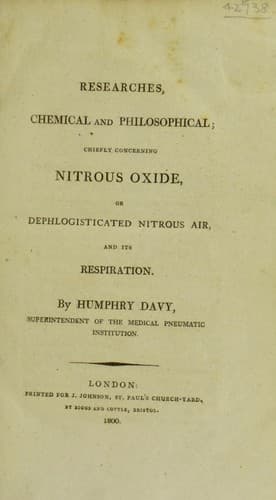
Researches Chemical and Philosophical; Chiefly concerning nitrous oxide: or dephlogisticated nitrous air and its respirationDavy, Humphry, Sir
Science
Researches Chemical and Philosophical; Chiefly concerning nitrous oxide: or dephlogisticated nitrous air and its respiration
Davy, Humphry, Sir
Nitrous oxide
Indeed, as most gases, though of different specific gravities, when
brought in contact with each other, assume some sort of union, it
is more than probable, that gas inspired into the lungs, from being
placed in contact with the residual gas on such an extensive surface,
must instantly mingle with it. Hence, possibly one deep inspiration
and compleat expiration of the whole of a quantity of hydrogene, will
be sufficient to determine the capacity of the lungs after compleat
voluntary exhaustion, and the nature of the residual air.
That two inspirations are sufficient, appears probable from the
following experiment.
E. 3. After a compleat voluntary expiration of common air, I made two
deep inspirations of 141 cubic inches of hydrogene. After the compleat
expiration, they filled a space equal to rather more than 142 cubic
inches, and analised, were found to consist of
Carbonic acid 3,1
Oxygene 4,5
Nitrogene 18,8
Hydrogene 115,6
—————
142,0
Now calculating on the exhausted capacity of my lungs from this
experiment, supposing uniform mixture, they would contain after
expiration of common air, about 30,7 cubic inches at 58°, equal to 36
at 98°, composed of about
Nitrogene 20,9
Oxygene 5,8
Carbonic acid 4,0
————
30,7
One should suppose a priori that in this experiment much less of the
residual oxygene of the lungs must have been absorbed, than in Expts. 1
and 2; yet there is no very marked difference in the portions evolved.
That a tolerably accurate mixture took place, appears from the quantity
of nitrogene. The smaller quantity of carbonic acid is an evidence in
favour of its evolution from the venous blood.
_c._ It is reasonable to suppose that the pressure upon the residual
gas of the exhausted lungs, must be nearly equal to that of the
atmosphere. But as aqueous vapour is perpetually given out by the
exhalents, and perhaps evolved from the moist coats of the pulmonary
vessels, it is likely that the residual gas is not only fully saturated
with moisture at 98°, but likewise impregnated with uncombined vapor;
and hence its volume enlarged beyond the increment of expansion of
temperature.
Considering all these circumstances, and calculating from the mean
of the three experiments on the composition of the residual gas, I
concluded,
1st. That the exhausted capacity of my lungs was equal to about 41
cubic inches.
2dly. That the gas contained in my bronchial vessels and fauces, after
a compleat expiration of atmospheric air, was equal to about 32 cubic
inches, its temperature being reduced to 55°.
3dly. That these 32 cubic inches were composed of about
Nitrogene 23,0
Carbonic acid 4,1
Oxygene 4,9
Public-domain text, read in full here on John Shaqi.
Reviews
Reviews
No reviews yet
Be the first to share your thoughts on this work.
Elsewhere in the archive
Join the Discussion
Join the discussion
Sign in to leave a comment or review.
Sign InorCreate an account