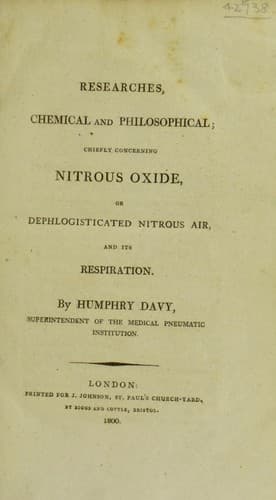
Researches Chemical and Philosophical; Chiefly concerning nitrous oxide: or dephlogisticated nitrous air and its respirationDavy, Humphry, Sir
Science
Researches Chemical and Philosophical; Chiefly concerning nitrous oxide: or dephlogisticated nitrous air and its respiration
Davy, Humphry, Sir
Nitrous oxide
And this remainder taken from 80,5 nitrous gas + 36,9 oxygene, leaves
52,4 cubic inches, which is the space occupied by the nitrous acid gas,
and which differs from 53,95 only by 1,55 cubic inches.
I ought to have observed, that before this conclusive experiment, two
similar ones had been made. In comparing the results of one of them,
performed with the assistance of my friend, Mr. JOSEPH PRIESTLEY, Dr.
PRIESTLEY’S eldest son, and chiefly detailed by him in the journal, I
find a coincidence greater than could be even well expected, where the
processes are so complex. According to that experiment, 41,5 grains
of nitrous acid gas fill a space equal to 53 cubic inches, and are
composed of nearly 29 nitrous gas, and 12,5 oxygene.
We may then conclude, First, that 100 cubic inches of nitrous acid,
such as exists in the[24] aëriform state saturated with oxygene, at
temperature 55°, and atmospheric pressure 30,1 weigh 75,17 grains.
[24] As is evident from the superabundant quantity of oxygene thrown
into the globe.
Secondly, that 100 grains of it are composed of 68,06 nitrous gas, and
31,94 oxygene. Or assuming what will be hereafter proved, that 100
parts of nitrous gas consist of 55,95 oxygene, and 44,05 nitrogene, of
29,9 nitrogene, and 70,1 oxygene; or taking away decimals, of 30 of the
one to 70 of the other.
Thirdly, that 100 grains of pale green solution of nitrous acid in
water, of specific gravity 1,301, are composed of 50,62 water, and 49,38
acid of the above composition.
VI. Having thus ascertained the composition of a standard acid, my next
object was to obtain it in a more condensed state, as it was otherwise
impossible to saturate it to its full extent with nitrous gas. But this
I could effect in no other way than by comparing mixtures of known
quantities of water, and acids of different specific gravities and
colors, with the acid of 1,301.
For the purpose of combining my acids with water, I made use of a
cylinder about 8 inches long, and,3 inches in diameter, accurately
graduated to grain measures, and furnished with a very tight stopper.
The concentrated acid was first slowly poured into it, and the water
gradually added till the required specific gravity was produced;[25]
the cylinder being closed and agitated after each addition, so as to
produce combination without any liberation of elastic fluid.
[25] The weight of the acid poured into the cylinder being known, its
specific gravity was known from the space it occupied in the phial.
The weight of water being likewise known, the specific gravity of the
solution, when the common temperature was produced, was given by the
condensation.
Public-domain text, read in full here on John Shaqi.
Reviews
Reviews
No reviews yet
Be the first to share your thoughts on this work.
Join the Discussion
Join the discussion
Sign in to leave a comment or review.
Sign InorCreate an account