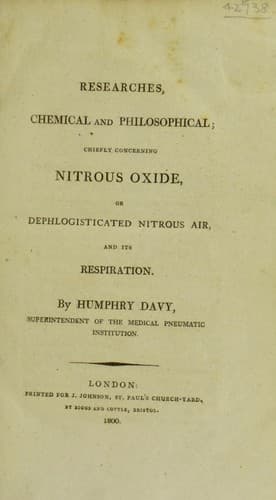
Researches Chemical and Philosophical; Chiefly concerning nitrous oxide: or dephlogisticated nitrous air and its respiration — John Shaqi
Researches Chemical and Philosophical; Chiefly concerning nitrous oxide: or dephlogisticated nitrous air and its respirationDavy, Humphry, Sir
Science
Researches Chemical and Philosophical; Chiefly concerning nitrous oxide: or dephlogisticated nitrous air and its respiration
Davy, Humphry, Sir
Nitrous oxide
After making a number of experiments with acids of different colors
in this advantageous way, I at length found that 90 grains of a deep
yellow acid, of specific gravity 1,5, became, when mingled at 40° with
77,5 grains of water, of specific gravity 1,302, and of a light green
tinge, as nearly as possible resembling that of the standard acid.
Supposing, then, that these acids contain nearly the same relative
proportions of oxygene and nitrogene, 100 grains of the deep yellow
acid of 1,5, are composed of 91,9 grains true nitrous acid,[26] and 8,1
grains of water.
[26] That is, such as it exists in the aëriform state at 55°. From the
strong affinity of nitrous acid for water, we may suppose that this
acid gas contains a larger proportion of it than the other gases.
To ascertain the difference between the composition of this acid,
and that of the pale, or nitric acid, of the same specific gravity,
I inserted 150 grains of it into a small cylindrical mattrass of the
capacity of,5 cubic inches, accurately graduated to grain measures,
and connected by a curved tube with the water apparatus. After heat had
been applied to the bottom of the mattrass for a few minutes, the color
of the fluid gradually changed to a deep red, whilst the globules of
gas formed at the bottom of the acid, were almost wholly absorbed in
passing through it. In a short time deep red vapour began to fill the
tube, and being condensed by the water in the apparatus, was converted
into a bright green fluid, at the same time that minute globules of
gas were given out. As the heat applied became more intense, a very
singular phænomenon presented itself; the condensed vapor, increased
in quantity, at length filled the curvature of the tube, and when
expelled, formed itself into dark green spherules, which sunk to the
bottom of the water, rested for a moment, and then resolved themselves
into nitrous gas.[27]
[27] This appearance will be explained hereafter.
When the acid was become completely pale, it was suffered to cool,
and weighed. It had lost near 15 grains, and was of specific gravity
1,491. 2 cubic inches and quarter of nitrous gas only were collected.
From this experiment evidently no conclusions could be drawn, as the
nitrous gas had carried over with it much nitrous acid (in the form of
what Dr. Priestley calls nitrous vapor) and was partially dissolved
with it in the water.[28]
[28] This phænomenon will be particularly explained hereafter.
To ascertain, then, the difference between the pale and yellow acids, I
was obliged to make use of synthesis, compared with analysis, carried
on in a different mode, by means of the following apparatus.
Public-domain text, read in full here on John Shaqi.
Reviews
Reviews
No reviews yet
Be the first to share your thoughts on this work.
Join the Discussion
Join the discussion
Sign in to leave a comment or review.
Sign InorCreate an account