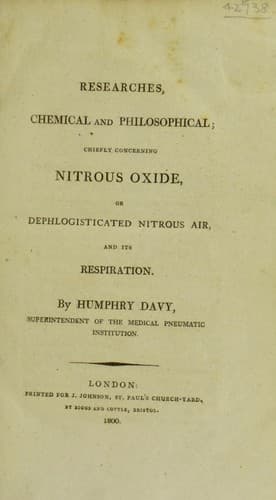
Researches Chemical and Philosophical; Chiefly concerning nitrous oxide: or dephlogisticated nitrous air and its respirationDavy, Humphry, Sir
Science
Researches Chemical and Philosophical; Chiefly concerning nitrous oxide: or dephlogisticated nitrous air and its respiration
Davy, Humphry, Sir
Nitrous oxide
_d._ In many experiments made in the mercurial airholder on the
capacity of my lungs under different circumstances, I found that I
threw out of my lungs by a full forced expiration at temperatures from
58° to 62°
cub. cub.
in. in.
After a full voluntary inspiration, from 189 to 191
After a natural inspiration, from 78 to 79
After a natural expiration, from 67 to 68
So that making the corrections for temperature, it would appear, that
my lungs in a state of voluntary inspiration, contained about 254
cubic inches; in a state of natural inspiration about 135; in a state
of natural expiration, about 118; and in a state of forced expiration
41.[197]
[197] This capacity is most probably below the medium, my chest is
narrow, measuring in circumference, but 29 inches, and my neck rather
long and slender.
As the exhausted capacity as well as impleted capacity of the internal
organs of respiration must be different in different individuals,
according as the forms and size of their thorax, fauces, and bronchia
are different, it would be almost useless to endeavour to ascertain a
standard capacity. It is however probable, that a ratio exists between
the quantities of air inspired in the natural and forced inspiration,
those expired in the natural and forced expiration, and the whole
capacity of the lungs. If this ratio were ascertained, a single
experiment on the natural inspiration and expiration of common air,
would enable us to ascertain the quantity of residual gas in the lungs
of any individual after a compleat forced expiration.[198]
[198] Dr. Goodwyn in his excellent work on the connexion of life with
respiration, has detailed some experiments on the capacity of the lungs
after natural expiration. He makes the medium capacity about 109 cubic
inches, which agrees very well with my estimation.—page 27.
V. _Additional observations and experiments on the Respiration of
Nitrous Oxide._
_a._ Having thus ascertained the capacity of my lungs, and the
composition of the residual gas of expiration, I proceeded to reason
concerning the experiments in section III, on the respiration of
nitrous oxide.
In Exp. I. nearly 100 cubic inches of nitrous oxide, making the
corrections on account of the common air, were respired for half a
minute. In this time, they were reduced to 62 cubic inches, which
consisted of 3,2 carbonic acid, 29 nitrous oxide, 4,1 oxygene, and 25,7
nitrogene.
Public-domain text, read in full here on John Shaqi.
Reviews
Reviews
No reviews yet
Be the first to share your thoughts on this work.
Elsewhere in the archive
Join the Discussion
Join the discussion
Sign in to leave a comment or review.
Sign InorCreate an account