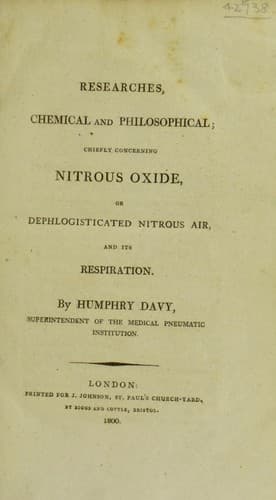
Researches Chemical and Philosophical; Chiefly concerning nitrous oxide: or dephlogisticated nitrous air and its respirationDavy, Humphry, Sir
Science
Researches Chemical and Philosophical; Chiefly concerning nitrous oxide: or dephlogisticated nitrous air and its respiration
Davy, Humphry, Sir
Nitrous oxide
But, as appears from the last section, there existed in the lungs
before the inspiration of the nitrous oxide, about 32 cubic inches of
gas, consisting of 23 nitrogene, 4,1 carbonic acid, and 4,9 oxygene,
temperature being reduced to 59°. This gas must have been perfectly
mingled with the nitrous oxide during the experiment; and consequently,
the residual gas in the lungs after the experiment, was of the same
composition as that in the airholder.
Supposing it as before, to be about 32 cubic inches: from the rule of
proportion, they will be composed of
Nitrous oxide 14,7
Nitrogene 13,3
Carbonic acid 1,9
Oxygene 2,1
And the whole quantity of gas in the lungs and the airholder, supposing
the temperature 59°, will equal 94 cubic inches, which are composed of
Nitrous oxide 43,7
Nitrogene 39,0
Carbonic acid 5,2
Oxygene 6,1
————
94
But before the experiment, the gas in the lungs and airholder equalled
134 cubic inches, and these, reckoning for the common air, were
composed of
Nitrous oxide 100
Nitrogene, 24,3
Carbonic acid 4,1
Oxygene 5,6
Hence, it appears, that 56,3 cubic inches of nitrous oxide were
absorbed in this experiment, and 13,7 of nitrogene produced, either
by evolution from the blood, or decomposition of the nitrous oxide.
The quantities of carbonic acid and oxygene approach so near to those
existing after the respiration of hydrogene, that there is every reason
to believe that no portion of them was produced in consequence of the
absorption, or decomposition of the nitrous oxide.
_b._ In Exp. 2, calculating in the same manner, before the first
inspiration, a quantity of gas equal to 216,5 cubic inches at 47°,
existed in the lungs and airholder, and these 216,5 cubic inches were
composed of
Nitrous oxide, 182,0
Nitrogene 24,9
Carbonic acid 4,1
Oxygene 5,5
——————
216,5
After the compleat expiration, 160 cubic inches remained in the lungs
and airholder, which was composed of
Nitrous oxide 110,6
Nitrogene 36,3
Carbonic acid 6,8
Oxygene 6,3
Hence, it appears, that 71,4 cubic inches of nitrous oxide were
absorbed in this experiment, and about 12 of nitrogene produced. The
quantity of carbonic acid and oxygene is rather greater than that which
existed in the experiments on hydrogene.
_c._ From these estimations, I learned that a small quantity of
nitrogene was produced during the absorption of nitrous oxide in
respiration. It remained to determine, whether this nitrogene owed its
production to evolution from the blood, or to the decomposition of a
portion of the nitrous oxide.
Public-domain text, read in full here on John Shaqi.
Reviews
Reviews
No reviews yet
Be the first to share your thoughts on this work.
Elsewhere in the archive
Join the Discussion
Join the discussion
Sign in to leave a comment or review.
Sign InorCreate an account