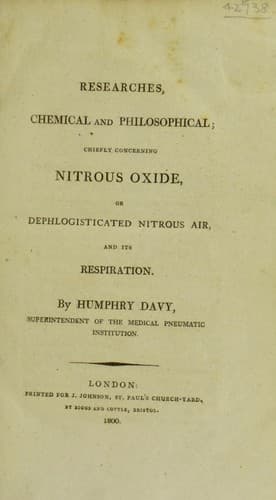
Researches Chemical and Philosophical; Chiefly concerning nitrous oxide: or dephlogisticated nitrous air and its respirationDavy, Humphry, Sir
Science
Researches Chemical and Philosophical; Chiefly concerning nitrous oxide: or dephlogisticated nitrous air and its respiration
Davy, Humphry, Sir
Nitrous oxide
Analogical evidences were not in favour of the hypothesis of
decomposition. It was difficult to suppose that a body requiring the
temperature of ignition for its decomposition by the most inflammable
bodies, should be partially absorbed and partially decompounded at 98°,
by a fluid apparently possessed of uniform attractions.
It was more easy to believe, that from the immense quantity of
nitrogene taken into the blood in nitrous oxide; the system soon
became overcharged with this principle, which not being wholly
expended in new combinations during living action, was liberated in
the aëriform state by the exhalents, or through the moist coats of the
veins.
Now if the last rationale were true, it would follow, that the
quantity of nitrogene produced in respiration, ought to be increased
in proportion as a greater quantity of nitrous oxide entered into
combination with the blood.
_d._ To ascertain whether this was the case, I made after full
voluntary exhaustion of my lungs, one full voluntary inspiration and
expiration of 108 cubic inches of nitrous oxide. After this, it filled
a space nearly equal to 99 cubic inches. The quantities of carbonic
acid and oxygene in these were not determined; but by the test of
absorption by water, they appeared to contain only 18 nitrogene; which
is very little more than should have been given from the residual gas
of the lungs.
In a second experiment, I made two respirations of 108 cubic inches
of nitrous oxide nearly pure. The diminution was to 95. On analysing
these 95, I found to my great surprise, that they contained only 17
nitrogene. Hence, I could not but suspect some source of error in the
process.
I now introduced into a strong new silk bag, the sides of which were
in perfect contact, about 8 quarts of nitrous oxide. From the mode of
introduction, this nitrous oxide must have been mingled with a little
common air, not however sufficient to disturb the results.
I then adapted a cork cemented to a long curved tube to my right
nostril; the tube was made to communicate with the water apparatus;
and the left nostril being accurately closed, and the mouth-piece of
the silk bag tightly adapted to the lips, I made a full expiration
of the common air of my lungs, inspired nitrous oxide from the bag,
and by carefully closing the mouth-piece with my tongue, expired it
through the curved tube into the water apparatus. In this way, I made
nine respirations of nitrous oxide. The expired gas of the first
respiration was not preserved; but part of the gas of the second,
third, fifth, seventh and ninth, were caught in seperate graduated
cylinders. The second, analised by absorption, consisted of about 29
absorbable gas, which must have been chiefly nitrous oxide; and 17
unabsorbable gas, which must have been chiefly nitrogene; and the third
of 22 absorbable gas, and 8 unabsorbable. The fifth was composed of 27
to 6; the seventh of 23 to 7, and the ninth of 26 to 11.
Public-domain text, read in full here on John Shaqi.
Reviews
Reviews
No reviews yet
Be the first to share your thoughts on this work.
Elsewhere in the archive
Join the Discussion
Join the discussion
Sign in to leave a comment or review.
Sign InorCreate an account