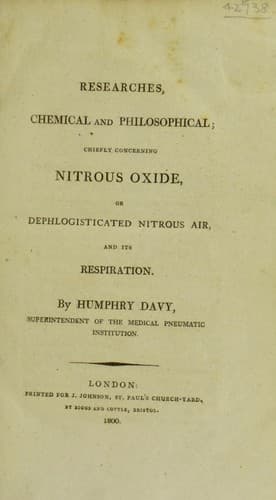
Researches Chemical and Philosophical; Chiefly concerning nitrous oxide: or dephlogisticated nitrous air and its respirationDavy, Humphry, Sir
Science
Researches Chemical and Philosophical; Chiefly concerning nitrous oxide: or dephlogisticated nitrous air and its respiration
Davy, Humphry, Sir
Nitrous oxide
_e._ Though the results of these experiments were not so conclusive as
could be wished; yet, comparing them with those of the experiments in
section III. it seemed reasonable to conclude, that the production of
nitrogene was increased, in proportion as the blood became more fully
impregnated with nitrous oxide.
From this conclusion, compared with the phænomenon noticed in section
2, and in Div. I. section 4, I am induced to believe that the
production of nitrogene during the respiration of nitrous oxide, is
not owing to the decomposition of part of the nitrous oxide, in the
aëriform state _immediately_ by the attraction of the red particles
of venous blood for its oxygene; but that it is rather owing to a new
arrangement produced in the principles of the impregnated blood, during
circulation; from which, becoming supersaturated with nitrogene, it
gives it out through the moist coats of the vessels.
For if any portion of nitrous oxide were decomposed immediately by the
red particles of the blood, one should conjecture, that the quantity of
nitrogene produced, ought to be greater during the first inspirations,
before these particles became fully combined with condensed oxygene.
If on the contrary, the whole of the nitrogene and oxygene of the
nitrous oxide were both combined with the blood, and carried through
the pulmonary veins and left chamber of the heart to the arteries;
then, supposing the oxygene chiefly expended in living action, whilst
the nitrogene was only partially consumed in new combinations, it
would follow, that the venous blood of animals made to breathe nitrous
oxide, hyper-saturated with nitrogene, must be different from common
venous blood; and this we have reason to believe from the phænomena in
Div. I. section 4, is actually the case.
_f._ Besides the nitrogene generated during the respiration of nitrous
oxide, we have noticed the evolution of other products, carbonic
acid,[199] and water.
[199] The oxygene as we have before noticed, most probably wholly
existed in the residual gas.
Now as nearly equal quantities of carbonic acid are produced, whether
hydrogene or nitrous oxide is respired, provided the process is carried
on for the same time; there is every reason to believe, as we have said
before, that no part of the carbonic acid produced, is generated from
the immediate decomposition of nitrous oxide by carbon existing in the
blood.
Consequently, in these experiments, it must be either evolved from the
venous blood; or formed, by the slow combination of the oxygene of the
residual air of respiration with the charcoal of the blood.
But if it was produced by the decomposition of residual atmospheric
air, it would follow, that its volume must be much less than that
of the oxygene of the residual air, which had disappeared; for some
of this oxygene must have been _absorbed_ by the blood, and during
the conversion of oxygene into carbonic acid by charcoal, a slight
diminution of volume is produced.
Public-domain text, read in full here on John Shaqi.
Reviews
Reviews
No reviews yet
Be the first to share your thoughts on this work.
Elsewhere in the archive
Join the Discussion
Join the discussion
Sign in to leave a comment or review.
Sign InorCreate an account