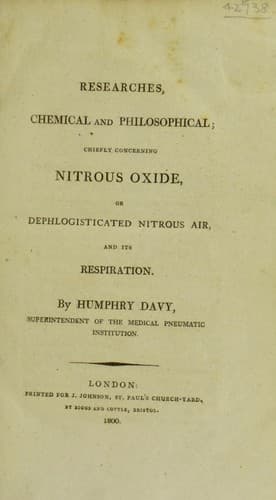
Researches Chemical and Philosophical; Chiefly concerning nitrous oxide: or dephlogisticated nitrous air and its respirationDavy, Humphry, Sir
Science
Researches Chemical and Philosophical; Chiefly concerning nitrous oxide: or dephlogisticated nitrous air and its respiration
Davy, Humphry, Sir
Nitrous oxide
In the experiments when nitrous oxide and hydrogene were respired for
about half a minute, the medium quantity of carbonic acid produced, was
5,6 cubic inches nearly.
Now we will assume, that the quantity of carbonic acid produced, is
in the ratio of the oxygene diminished; and there is every reason to
believe, that in the expiration of atmospheric air, the expired air and
the residual air are nearly of the same composition.
Hence, no more carbonic acid can remain in the lungs or be produced
from the residual gas after the compleat expiration of common air,
than that which can be generated from a volume of atmospheric air
equal to the residual gas of the lungs.
The residual gas of the lungs, after compleat expiration, equals at
55°, 32 cubic inches, and 32 cubic inches of common air contain 8.6
cubic inches of oxygene.
But in the experiments on the respiration of hydrogene, not only
5.6 cubic inches of carbonic acid were produced, but more than 4 of
residual oxygene remained unabsorbed.
Hence it appears impossible that all the carbonic acid evolved from the
lungs during the respiration of nitrous oxide or hydrogene could have
been produced by the combination of charcoal in the venous blood with
residual atmospheric oxygene: there is consequently every reason to
believe that it is wholly or partially liberated from the venous blood
through the moist coats of the vessels.
_g._ The water carried out of the lungs in solution by the expired gas
of nitrous oxide, could neither have been wholly or partially formed
by the decomposition of nitrous oxide. The coats of the vessels in the
lungs, and indeed in the whole internal surface of the body, are always
covered with moisture, and the solution of part of this moisture by
the inspired heated gas, and its deposition by the expired gas, are
sufficient causes for the appearance of the phænomenon.
There are no reasons for supposing that any of the residual atmospheric
oxygene is immediately combined with fixed or nascent hydrogene, or
hydrocarbonate, in the venous blood at 98°, by slow combustion, and
consequently none for supposing that water is immediately formed in
respiration.
The evolution of water from the vessels in the lungs, is almost certain
from numerous analogies.
Public-domain text, read in full here on John Shaqi.
Reviews
Reviews
No reviews yet
Be the first to share your thoughts on this work.
Elsewhere in the archive
Join the Discussion
Join the discussion
Sign in to leave a comment or review.
Sign InorCreate an account