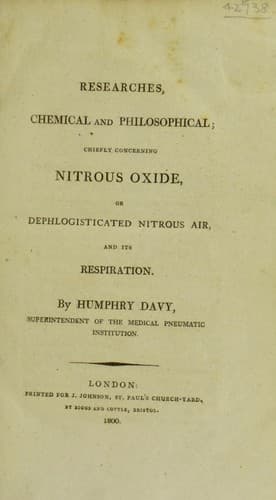
Researches Chemical and Philosophical; Chiefly concerning nitrous oxide: or dephlogisticated nitrous air and its respirationDavy, Humphry, Sir
Science
Researches Chemical and Philosophical; Chiefly concerning nitrous oxide: or dephlogisticated nitrous air and its respiration
Davy, Humphry, Sir
Nitrous oxide
_h._ As from the experiments in section II. it appeared that nitrous
oxide was capable of being combined with oxygenated blood, and vice
versa, blood impregnated with nitrous oxide capable of oxygenation; I
was curious to ascertain what changes would be effected in nitrous
oxide when it was respired, mingled with atmospheric air or oxygene.
For this purpose, without making a very delicate experiment, I breathed
in the large mercurial airholder about 112 cubic inches of nitrous
oxide, mingled with 44 of common air, for near half a minute, in the
usual mode. The gas, after expiration, filled a space nearly equal to
119. I did not exactly ascertain the composition of the residual gas;
it supported flame rather better than common air, and after the nitrous
oxide was absorbed, gave much less diminution with nitrous gas than
atmospheric air.
_i._ I breathed a mixture of four quarts of nitrous oxide with three
quarts of hydrogene, in a dry silk bag, for near a minute; an evident
diminution was produced; but on account of the mode of experimenting it
was impossible to determine the quantity of nitrous oxide absorbed, or
the exact nature of the products. When a taper was introduced into a
little of the residual gas, it inflamed with a very feeble explosion.
Now a mixture of 4 parts nitrous oxide and 3 hydrogene, detonates when
inflamed with very great violence.
_k._ Nitrous oxide can be respired without danger by the human animal
for a much longer time than that required for the death of the smaller
quadrupeds in it.
I have breathed it two or three times in a considerable state of
purity, in a dry silk bag, for four minutes and quarter and four
minutes and half: some diseased individuals have respired it for
upwards of five minutes.
In the infancy of my experiments, from general appearances, I thought
that the proportion of nitrous oxide absorbed in respiration was
greater in the first inspirations than the last; but this I have
since found to be a mistake. In the last respirations the apparent
absorption is indeed less; but this is on account of the increased
evolution of nitrogene from the blood. When nitrous oxide is respired
for a long time, the last inspirations are always fuller and quicker
than the first; but the consumption by the same individual is nearly in
the ratio of the time of respiration. Three quarts, i. e. about 174
cubic inches, are consumed so as to be unfit for respiration, by an
healthy individual with lungs of moderate capacity, in about a minute
and quarter; six quarts, or 348 cubic inches, last generally for two
minutes and half or two minutes and three quarters; eight quarts, or
464 cubic inches, for more than three minutes and half; and twelve, or
696 cubic inches, for nearly five.
Public-domain text, read in full here on John Shaqi.
Reviews
Reviews
No reviews yet
Be the first to share your thoughts on this work.
Elsewhere in the archive
Join the Discussion
Join the discussion
Sign in to leave a comment or review.
Sign InorCreate an account