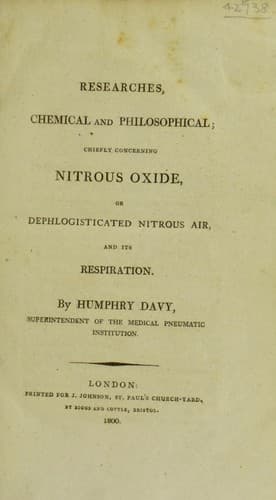
Researches Chemical and Philosophical; Chiefly concerning nitrous oxide: or dephlogisticated nitrous air and its respirationDavy, Humphry, Sir
Science
Researches Chemical and Philosophical; Chiefly concerning nitrous oxide: or dephlogisticated nitrous air and its respiration
Davy, Humphry, Sir
Nitrous oxide
The quantities of nitrous oxide absorbed by the same individual, will,
as there is every reason to suppose, be different under different
circumstances, and will probably be governed in some measure by the
state of the health. It is reasonable to suppose, that the velocity of
the circulation must have a considerable influence on the absorption
of nitrous oxide; probably in proportion as it is greater a larger
quantity of gas will be consumed in equal times.
I am inclined from two or three experiments, to believe that
nitrous oxide is absorbed more rapidly after hearty meals or during
stimulation from wine or spirits, than at other times. As its
absorption appears to depend on a simple solution in the venous blood;
probably diminution of temperature will increase its capability of
being absorbed.
_l._ The quantities of nitrous oxide absorbed by different individuals,
will probably be governed in some measure by the size of their lungs
and the surface of the blood vessels, all other circumstances being the
same.
From the observations that I have been able to make on the absorption
of nitrous oxide, as compared with the capacity of the lungs, the range
of the consumption of different individuals does not extend to more
than a pint, or 30 cubic inches at the maximum dose.
We may therefore conclude, that the medium consumption of nitrous oxide
by the respiration of different individuals, is not far from two cubic
inches, or about a grain every second, or 120 cubic inches, or 60
grains every minute.
_m._ When nitrous oxide is breathed in tight silk bags, towards the end
of the experiment as the internal surface becomes moist, as I have
before mentioned, a certain quantity of common air penetrates through
it and becomes mixed with the residual gas of the experiment; but this
quantity is always too small to destroy any of the effects of the
nitrous oxide. The residual gas of the common air, the nitrogene and
carbonic acid produced in the process, and the residuum of the admitted
atmospheric air, hardly ever amount after the experiment, to one half
of the volume of the nitrous oxide absorbed. There is consequently, a
perfect propriety in successively inspiring and expiring the whole of
a given quantity of nitrous oxide, till it is nearly consumed. In the
respiration of nitrous oxide as the gas is absorbed and not decomposed,
little will be gained in effect, by perpetually inspiring and expiring
new portions, whilst an immense quantity of gas will be idly wasted,
and this circumstance, considering the expence of the substance, is of
importance.
VI. _On the respiration of Atmospheric Air._
Public-domain text, read in full here on John Shaqi.
Reviews
Reviews
No reviews yet
Be the first to share your thoughts on this work.
Elsewhere in the archive
Join the Discussion
Join the discussion
Sign in to leave a comment or review.
Sign InorCreate an account