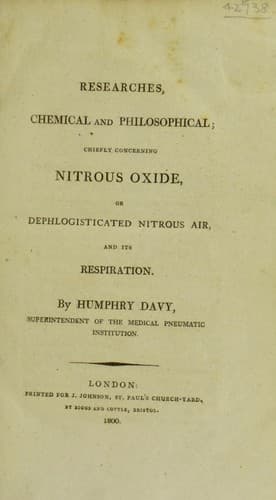
Researches Chemical and Philosophical; Chiefly concerning nitrous oxide: or dephlogisticated nitrous air and its respirationDavy, Humphry, Sir
Science
Researches Chemical and Philosophical; Chiefly concerning nitrous oxide: or dephlogisticated nitrous air and its respiration
Davy, Humphry, Sir
Nitrous oxide
Having thus ascertained the absorption of nitrous oxide in respiration,
and the evolution of nitrogene and carbonic acid from the lungs during
its absorption: considering atmospheric air as a compound in which
principles identical with those in nitrous oxide existed, though in
different quantities and looser combination, I was anxious to compare
the changes effected in this gas by respiration, with those produced in
nitrous oxide and oxygene; particularly as they are connected with the
health and life of animals.
The ingenious experiments of Lavoisier and Goodwyn, prove the
consumption of oxygene in respiration, and the production of carbonic
acid. From many experiments on the respiration of common air, Dr.
Priestly suspected that a certain portion of nitrogene, as well as
oxygene, was absorbed by the venous blood.
_b._ In the following experiments on the respiration of atmospheric
air in the mercurial airholder; the composition of the gas before
inspiration and after expiration, was ascertained in the following
manner.
Forty measures of it were agitated over mercury in solution of
caustic potash, and suffered to remain in contact with it for two or
three hours. The diminution was noted, and the gas absorbed judged
to be carbonic acid. Twenty measures of the gas, freed from carbonic
acid, were mingled with thirty of nitrous gas, in a tube of,5 inches
diameter; they were not agitated,[200] but suffered to rest for an hour
or an hour and half, when the volume occupied by them was noticed: and
50-_m_ the volume occupied, divided by 3 considered as the oxygene _x_,
and 20-_x_ considered as the nitrogene.
[200] When they are agitated, a greater proportion of nitrous gas is
absorbed, condensed in the nitric acid by the water; and to find the
oxygene,
(50 - _m_) (50 - _m_)
_x_ = —————————— or ————————— .
(3,4) (3,5)
_c._ To ascertain the changes effected in atmospheric air by single
inspirations,
I made, after a compleat voluntary exhaustion of my lungs, at
temperature 61°, one inspiration and expiration of 141 cubic inches of
atmospheric air. After expiration, they filled a space equal to 139
cubic inches nearly. These 139 cubic inches analised were found to
consist of
Nitrogene 101
Oxygene 32
Carbonic acid 6
The 141 cubic inches before inspiration, were composed of 103
nitrogene, 1 carbonic acid and 37 oxygene. The time taken to perform
the inspiration and full expiration, was nearly a quarter of a minute.
I repeated this experiment seven or eight times, and the quantity of
oxygene absorbed was generally from 5 to 6 cubic inches, the carbonic
acid formed from 5 to 5,5, and the quantity of nitrogene apparently
diminished by from 1 to 3 cubic inches.
E. 2. I made, after a voluntary expiration of common air, one
inspiration and full expiration of 100 cubic inches of atmospheric air.
It was diminished nearly to 98¾ or 99 cubic inches, and analised, was
found to consist of
Public-domain text, read in full here on John Shaqi.
Reviews
Reviews
No reviews yet
Be the first to share your thoughts on this work.
Elsewhere in the archive
Join the Discussion
Join the discussion
Sign in to leave a comment or review.
Sign InorCreate an account