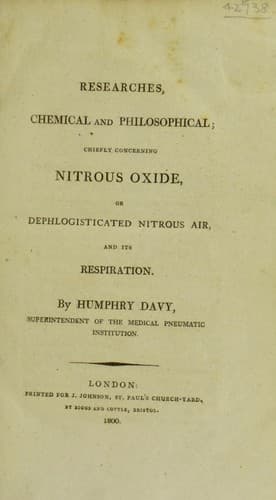
Researches Chemical and Philosophical; Chiefly concerning nitrous oxide: or dephlogisticated nitrous air and its respirationDavy, Humphry, Sir
Science
Researches Chemical and Philosophical; Chiefly concerning nitrous oxide: or dephlogisticated nitrous air and its respiration
Davy, Humphry, Sir
Nitrous oxide
Nitrogene 71,7
Oxygene 22,5
Carbonic acid 4,5
This experiment I likewise repeated four or five times, with very
little difference of result, and there always seemed to be a small
diminution of nitrogene. I made no corrections on account of the
residual air of the lungs in these processes, because there was every
reason to suppose that it was always of similar composition.
_c._ Before I could ascertain whether similar changes were effected
in atmospheric air, by natural inspirations as by forced ones, I
was obliged to practise respiration in the mercurial airholder, by
differing the conducting tube to communicate with the atmosphere till I
had attained the power of breathing in it naturally, without labor or
attention; I then found by a number of experiments, that I took into my
lungs at every natural inspiration, about 13 cubic inches of air, and
that I threw out of my lungs at every expiration,[201] rather less than
this quantity; about 12¾ cubic inches.
[201] The diminution of air by single inspirations, was particularly
noticed by Dr. Goodwyn.
The mean composition of the 13 cubic inches of air inspired, was
cub. in.
Nitrogene 9,5
Oxygene 3,4
Carbonic acid 0,1
That of the 12,7 of air expired
Nitrogene 9,3
Oxygene 2,2
Carbonic acid 1,2
These results I gained from more than 20 experiments, so that I could
not possibly entertain any doubt of this accuracy.
I found, by making a person observe my respirations when I was
inattentive to the process, that I made about 26 or 27 natural
inspirations in a minute. So that calculating from the above
estimations, it would follow, that 31,6 cubic inches of oxygene were
consumed, and 5,2 inches of nitrogene lost in respiration every minute,
whilst 26,6 cubic inches of carbonic acid were produced.
To collect the products of a great number of natural expirations so
as to ascertain whether their composition corresponded with the above
accounts, I proceeded in the following manner.
I fastened my lips tight on the mouth-piece of the exhausted airholder,
and suffering my nostrils to remain open, inspired naturally through
them, throwing the expired air through my mouth into the airholder.
In many experiments, I found that in about a half a minute, I made in
this way 14 or 15 expirations. The mean quantity of air collected was
171 cubic inches, and consisted of
cub. in.
Nitrogene 128
Oxygene 29
Carbonic acid 14
Comparing these results with the former ones, we find the mean
quantities of air respired in equal terms rather less; but the
proportions of carbonic acid, nitrogene and oxygene in the respired
air, nearly identical.
Public-domain text, read in full here on John Shaqi.
Reviews
Reviews
No reviews yet
Be the first to share your thoughts on this work.
Elsewhere in the archive
Join the Discussion
Join the discussion
Sign in to leave a comment or review.
Sign InorCreate an account