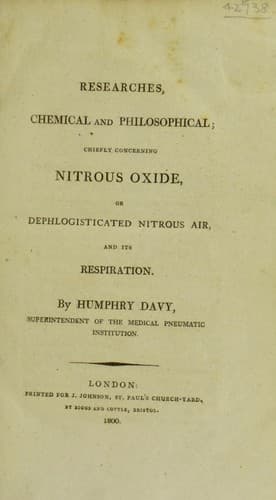
Researches Chemical and Philosophical; Chiefly concerning nitrous oxide: or dephlogisticated nitrous air and its respirationDavy, Humphry, Sir
Science
Researches Chemical and Philosophical; Chiefly concerning nitrous oxide: or dephlogisticated nitrous air and its respiration
Davy, Humphry, Sir
Nitrous oxide
_e._ To ascertain the changes effected in a given quantity of
atmospheric air by continued respirations, I breathed after a compleat
expiration, at temperature 63°, 161 cubic inches of air for near a
minute, making in this time, 19 deep inspirations. After the compleat
expiration, which was very carefully made, the gas filled a space
nearly equal to 152 cubic inches, so that 9 cubic inches of gas had
disappeared.
The 152 cubic inches analised, were found to consist of
cub. in.
Nitrogene 111,6
Oxygene 23,
Carbonic acid, 17,4
The 161 cubic inches before inspiration, were composed of
cub. in.
Nitrogene 117,0
Oxygene 42,4
Carbonic acid 1,6
But the residual gas in the lungs before the experiment, was of
different composition from that remaining in the lungs after the
experiment. Making corrections on account of this circumstance, as in
section IV. it appears that about 5,1 of nitrogene were absorbed in
respiration, 23,9 of oxygene consumed, and 12 of carbonic acid produced.
I repeated this experiment three times; in each experiment the
diminution after respiration, was nearly the same; and the residual
gas making the necessary allowances, of similar composition. So that
supposing the existence of no source of error in the experiments from
which the quantity and composition of the residual gas of the lungs
were estimated in section IV. the absorption of nitrogene by the venous
blood, appears almost demonstrated.
_f._ To compare the changes effected in atmospheric air by respiration
of the smaller quadrupeds, with those in the experiments just detailed,
I introduced into a jar of the capacity of 20 cubic inches filled
with mercury in the mercurial trough, 15 cubic inches of atmospheric
air which had been deprived of its carbonic acid by long exposure, to
solution of potash.
Temperature being 64°, a healthy small mouse was quickly passed under
the mercury into the jar, and suffered to rest on a very thin bit of
cheese, which was admitted immediately after.
He continued for near 40 minutes without apparently suffering,
occasionally raising himself on his hind legs. At the end of 50
minutes, he was lying on his side, and in 55 minutes was apparently
dying. He was now carefully taken out through the mercury by the tail,
and exposed before the fire, where he soon recovered. After the cheese
had been carefully removed, the gas in the jar filled a space nearly
equal to 14 cubic inches; so that a diminution of a cubic inch had
taken place. These 14 cubic inches analised, were found to consist of
cub. in.
Carbonic acid 2,0
Oxygene 1,4
Nitrogene 10,6
The 15 cubic inches before the experiment, consisted of
cub. in.
Oxygene 4
Nitrogene 11
Public-domain text, read in full here on John Shaqi.
Reviews
Reviews
No reviews yet
Be the first to share your thoughts on this work.
Elsewhere in the archive
Join the Discussion
Join the discussion
Sign in to leave a comment or review.
Sign InorCreate an account