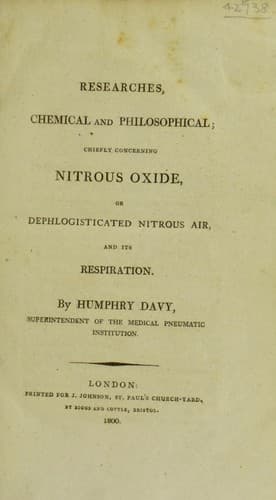
Researches Chemical and Philosophical; Chiefly concerning nitrous oxide: or dephlogisticated nitrous air and its respirationDavy, Humphry, Sir
Science
Researches Chemical and Philosophical; Chiefly concerning nitrous oxide: or dephlogisticated nitrous air and its respiration
Davy, Humphry, Sir
Nitrous oxide
Hence it appeared, that 2,6 cubic inches of oxygene had been consumed,
2 cubic inches of carbonic acid produced, and about 0,4 of nitrogene
lost.
The relation between the quantities of oxygene consumed in this
experiment, and the carbonic acid produced, are nearly the same as
that of those in the experiments just detailed; but the quantity of
nitrogene lost is much smaller.
VII. _Respiration of Oxygene._
The gases before and after respiration, were analised in these
experiments in the manner described in the last section, except that 3
of nitrous gas were always employed to one of oxygene.
E. I. At temperature 53°, after a full forced respiration, I respired
in the mercurial airholder, for half a minute, 102 cubic inches of
oxygene, making seven very long and deep inspirations. After the
compleat expiration, the gases filled a space equal to 93 cubic inches;
these 93 cubic inches analised, were found to consist of
cub. in.
Carbonic acid 5,9
Nitrogene 33,8
Oxygene 53,3
The 102 cubic inches before the experiment, were composed of
cub. in.
Oxygene 78
Nitrogene 24
The residual gas in the lungs before the experiment, was 32 cubic
inches, and composed of about 23 nitrogene, 4,1 carbonic acid, and 4,9
oxygene, Section IV. The residual gas after expiration, was composed of
18,2 oxygene, 2 carbonic acid, and 11,8 nitrogene.
Hence the whole of the gas in the lungs and airholder before
inspiration, was 134 cubic inches, composed of
cub. in.
Oxygene 82,9
Nitrogene 47,0
Carbonic acid 4,1
And after respiration, 125 cubic inches, consisting of
cub. in.
Oxygene 71,5
Nitrogene 45,6
Carbonic acid 7,9
So that comparing the quantities, it appears, that 11,4 of oxygene and
1,4 of nitrogene, were consumed in this experiment, and 3,8 of carbonic
acid produced.
I was much surprised at the small quantity of oxygene that had been
consumed in this experiment. This quantity was less than that expended
during the respiration of atmospheric air for half a minute: the
portion of carbonic acid evolved was likewise smaller. I could detect
no source of inaccuracy, and it was difficult to suppose that the
greater depth and fulness of the inspirations could make any difference.
E. 2. I now respired at the same temperature, after a full expiration,
162 cubic inches of gas, composed of 133 oxygene and 20 nitrogene for
two minutes, imitating as much as possible, the natural respiration.
After the experiment, they filled a space equal to 123 cubic inches.
And when the analysis and calculations had been made as in the last
experiment, it appeared that 57 cubic inches of oxygene, and 2 of
nitrogene had been absorbed, whilst 21 cubic inches of carbonic acid
had been formed.
Public-domain text, read in full here on John Shaqi.
Reviews
Reviews
No reviews yet
Be the first to share your thoughts on this work.
Elsewhere in the archive
Join the Discussion
Join the discussion
Sign in to leave a comment or review.
Sign InorCreate an account