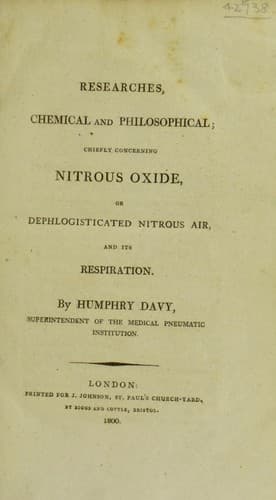
Researches Chemical and Philosophical; Chiefly concerning nitrous oxide: or dephlogisticated nitrous air and its respirationDavy, Humphry, Sir
Science
Researches Chemical and Philosophical; Chiefly concerning nitrous oxide: or dephlogisticated nitrous air and its respiration
Davy, Humphry, Sir
Nitrous oxide
Now from the estimations in the last section, it appears that 63 cubic
inches of oxygene are consumed, and about 52 cubic inches of carbonic
acid produced every two minutes during the natural respiration of
common air. So that supposing the experiment accurate, 6 cubic inches
of oxygene less are absorbed, and 30 cubic inches less of carbonic acid
produced every minute, when oxygene nearly pure is respired, than when
atmospheric air is respired.
Both these experiments were made in the morning, at a time when I was
in perfect health; so that there could be apparently no source of error
from accidental circumstances.
The uncommon and unexpected nature of the results, made me however,
very sceptical concerning them; and before I would draw any inferences,
I resolved to ascertain the comparative consumption of atmospheric air
and oxygene by the smaller quadrupeds, for which purpose, I made the
following experiment.
E. 3. Of two strong and healthy small mice, apparently of the same
breed, and exactly similar.
One was introduced into a jar containing 10 cubic inches and half of
oxygene, and 3 cubic inches of nitrogene, and made to rest on a bit of
cheese.
The other was introduced into a jar containing fifteen cubic inches and
half of atmospheric air, and made to rest in the same manner on cheese.
The mouse in oxygene began apparently to suffer in about half an hour,
and occasionally panted very much; in about an hour he lay down on his
side as if dying. The jars were often agitated, that the gases might be
well mingled.
The mouse in atmospheric air became very feeble in 40 minutes, and at
the end of 50 minutes was taken out through the mercury alive, but
unable to stand.
The mouse in oxygene was taken out in the same manner after an hour and
quarter, alive, but motionless, and breathing very deeply.
The gas in the jars was examined. That in the oxygene jar filled a
space exactly equal to 12,7 cubic inches, and analised, was found to
consist of 1,7 carbonic acid, 2,6 of nitrogene, and 8,4 of oxygene. So
that absolutely, 2,1 cubic inches of oxygene and,4 of nitrogene had
been consumed, and 1,7 of carbonic acid produced.
The gas in the atmospheric air jar was diminished nearly to 14,4, and
consisted of 2,1 carbonic acid, 1,4 oxygene; and 10,9 nitrogene. So
that 2,7 of oxygene and,5 of nitrogene, had been consumed by the mouse;
and 2,1 of carbonic acid produced.
Hence it appears, that the mouse in atmospheric air consumed nearly
one third more oxygene and produced nearly one fourth more carbonic
acid in respiration in 55 minutes, than the other in an hour and
quarter in oxygene. And if we consider the perpetual diminution of the
oxygene of the atmospheric air; from which at last it became almost
incapable of supporting the life of the animal; we may conclude, that
the quantity of oxygene consumed by it, had the air been perpetually
renovated, would have been much more considerable.
Public-domain text, read in full here on John Shaqi.
Reviews
Reviews
No reviews yet
Be the first to share your thoughts on this work.
Elsewhere in the archive
Join the Discussion
Join the discussion
Sign in to leave a comment or review.
Sign InorCreate an account