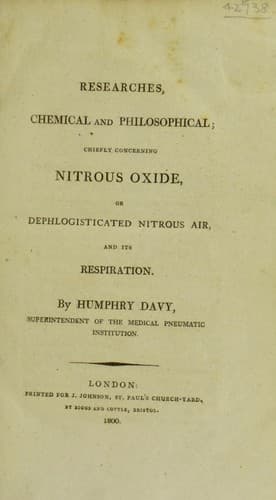
Researches Chemical and Philosophical; Chiefly concerning nitrous oxide: or dephlogisticated nitrous air and its respirationDavy, Humphry, Sir
Science
Researches Chemical and Philosophical; Chiefly concerning nitrous oxide: or dephlogisticated nitrous air and its respiration
Davy, Humphry, Sir
Nitrous oxide
The quickness of the operation of nitrous oxide, will probably render
it useful in cases of extreme debility produced by deficiency of
common exciting powers. Perhaps it may be advantageously applied
mingled with oxygene or common air, to the recovery of persons
apparently dead from suffocation by drowning or hanging.
The only diseases in which nitrous oxide has been hitherto employed,
are those of deficient sensibility.—An account of its agency in
paralytic affections, will be speedily published by Dr. Beddoes.
As by its immediate operation the tone of the irritable fibre is
increased, and as exhaustion rarely follows the violent muscular
motions sometimes produced by it, it is not unreasonable to expect
advantages from it in cases of simple muscular debility.
The apparent general transiency of its operation in the pure form
in single doses has been considered as offering arguments against
its power of producing lasting changes in the constitution. It will,
however, be easy to keep up excitement of different degrees of
intensity for a great length of time, either by administering the
unmingled gas in rapid successive doses, or by preserving a permanent
atmosphere, containing different proportions of nitrous oxide and
common air, by means of a breathing chamber.[231] That single doses
nevertheless, are capable of producing permanent effects in some
constitutions, is evident, as well from the hysterical cases as from
some of the details—particularly that of Mr. M. M. Coates.
[231] See R. IV. Div. I. page 478.
As nitrous oxide in its extensive operation appears capable of
destroying physical pain, it may probably be used with advantage during
surgical operations in which no great effusion of blood takes place.
From the strong inclination of those who have been pleasantly affected
by the gas to respire it again, it is evident, that the pleasure
produced, is not lost, but that it mingles with the mass of feelings,
and becomes intellectual pleasure, or hope. The desire of some
individuals acquainted with the pleasures of nitrous oxide for the gas
has been often so strong as to induce them to breathe with eagerness,
the air remaining in the bags after the respiration of others.
As hydrocarbonate acts as a sedative,[232] and diminishes living action
as rapidly as nitrous oxide increases it, on the common theory of
excitability[233] it would follow, that by differently modifying the
atmosphere by means of this gas and nitrous oxide, we should be in
possession of a regular series of exciting and depressing[234] powers
applicable to every deviation of the constitution from health: but
the common theory of excitability is most probably founded on a false
generalisation. The modifications of diseased action may be infinite
and specific in different organs; and hence out of the power of agents
operating on the whole of the system.
[232] R. IV. Div. I. page 467.
[233] That of Brown modified by his disciples.
Public-domain text, read in full here on John Shaqi.
Reviews
Reviews
No reviews yet
Be the first to share your thoughts on this work.
Elsewhere in the archive
Join the Discussion
Join the discussion
Sign in to leave a comment or review.
Sign InorCreate an account