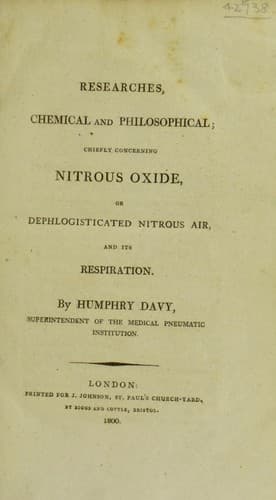
Researches Chemical and Philosophical; Chiefly concerning nitrous oxide: or dephlogisticated nitrous air and its respiration — John Shaqi
Researches Chemical and Philosophical; Chiefly concerning nitrous oxide: or dephlogisticated nitrous air and its respirationDavy, Humphry, Sir
Science
Researches Chemical and Philosophical; Chiefly concerning nitrous oxide: or dephlogisticated nitrous air and its respiration
Davy, Humphry, Sir
Nitrous oxide
[52] Dr. Priestley says, “Having filled a phial containing exactly
the quantity of four pennyweights of water, with strong, pale, yellow
spirit of nitre, with its mouth quite close to the top of a large
receiver standing in water, I carefully drew out almost all the common
air, and then filled it with nitrous air; and as this was absorbed,
I kept putting in more and more, till in less than two days it had
completely absorbed 130 ounce measures. Presently after this process
began, the surface of the acid assumed a deep orange color, and when 20
or 30 ounce measures of air were absorbed, it became green at the top:
this green descended lower and lower, till it reached the bottom of the
phial. Towards the end of the process, the evaporation was perceived to
be very great, and when I took it out, the quantity was found to have
diminished to one half. Also it had become, by means of this process,
and the evaporation together, exceeding weak, and was rather blue than
green.”
_Experiments and Observations_, vol. 1, p. 384. Last edition. XIV.
The opinions heretofore adopted respecting the quantities of real or
true acid in solutions of nitrous acid of different specific gravities,
have been founded on experiments made on the nitro-neutral salts,
the most accurate of which are those of Kirwan, Bergman, and Wenzel.
The great difference in the results of these celebrated men, proves
the difficulty of the investigation, and the existence of sources of
error.[53] Kirwan deduces the composition of the solutions of nitrous
acid in water, from an experiment on the formation of nitrated soda.
In this experiment, 36,05 grains of soda were saturated by 145 grains
of nitrous acid, of specific gravity 1,2754. By a test experiment, he
found the quantity of salt formed to be 85,142 grains.[54] Hence he
concludes that 100 parts of nitrous acid, of specific gravity 1,5543,
contain 73,54 of the strongest, or most concentrated acid.
[53] See Mr. Keir’s excellent observations on this subject. Chem. Dict.
Art. Acid.
[54] Irish Transactions, vol. 4, p. 34.
Supposing his estimation perfectly true, 100 parts of the aëriform acid
of 55° would be composed of 74,54 of his real acid, and 25,46 water.
In examining, however, one of his later experiments,[55] we shall find
reasons for concluding, that the acid in nitrated soda cannot contain
much less water than the aëriform acid. A solution of carbonated soda,
containing 125 grains of real alkali, was saturated by 306,2 grains of
nitrous acid, of specific gravity 1,416. The evaporation was carried
on in a temperature not exceeding 120°, and the residuum exposed to a
heat of 400° for six hours, at the end of which time it weighed 308
grains. Now according to my estimation, 306 grains of nitric acid, of
1,416, should contain 215 true acid; and we can hardly suppose, but
that during the evaporation and consequent long exposure to heat, some
of the nitrated soda was lost with the water.
[55] Addit. Obs. pag. 74.
Public-domain text, read in full here on John Shaqi.
Reviews
Reviews
No reviews yet
Be the first to share your thoughts on this work.
Join the Discussion
Join the discussion
Sign in to leave a comment or review.
Sign InorCreate an account