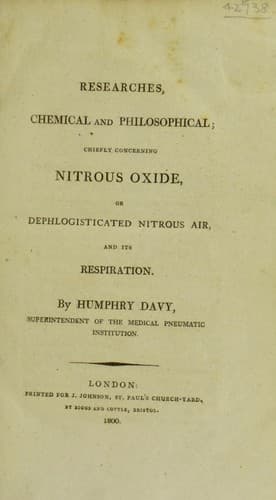
Researches Chemical and Philosophical; Chiefly concerning nitrous oxide: or dephlogisticated nitrous air and its respiration — John Shaqi
Researches Chemical and Philosophical; Chiefly concerning nitrous oxide: or dephlogisticated nitrous air and its respirationDavy, Humphry, Sir
Science
Researches Chemical and Philosophical; Chiefly concerning nitrous oxide: or dephlogisticated nitrous air and its respiration
Davy, Humphry, Sir
Nitrous oxide
The products, instead of being simply carbonic acid, and nitrogene, are
carbonic acid, nitrogene, nitrous acid, probably ammonia, and sometimes
nitrous gas. The nitrous acid is disengaged from the base by the
intense heat. Concerning the formation of the ammonia, it is useless to
reason till we have obtained unequivocal testimonies of its existence;
it may be produced either by the decomposition of the water contained
in the nitre, by the combination of its oxygene with the charcoal, and
of its nascent hydrogene with the nitrogene of the nitric acid; or from
some unknown decomposition of the potash.
As neither Lavoisier nor Berthollet found nitrous gas produced in
the decomposition of nitre by charcoal, when a water apparatus was
employed; and as it was not uniformly evolved in my experiments, the
most probable supposition is, that it arises from the decomposition of
a portion of the free nitrous acid intensely heated, by the mercury.
In none of my experiments was the whole of the nitre and charcoal
decomposed, some of it was uniformly thrown with the gases into the
mercurial apparatus. The nitrogene evolved, as far as I could ascertain
by the common tests, was mingled with no inflammable gas.
If we consider experiment _f_ as accurate, with regard to the relative
quantities of carbonic acid and nitrogene produced, they are to each
other nearly as 20 to 8; that is, allowing 2 for the nitrous gas, and
consequently, reasoning in the same manner as Lavoisier, concerning the
composition of nitric acid, it should be composed of 1 nitrogene to
3,38 oxygene. But though the quantity of oxygene in this estimation is
far short of that given in his, yet still it is too much. From whatever
source the errors arise, whether from the evolution of phlogisticated
nitrous acid, or the decomposition of water, or the production of
nitrous gas, they all tend to increase the proportion of the carbonic
acid to the nitrogene.
I am unacquainted with any experiment from which accurate opinions
concerning the different relative proportions of oxygene and nitrogene
in the nitric and nitrous acids could be deduced. Lavoisier’s
calculation is founded on his fundamental experiment, and on the
combination of nitrous gas and oxygene.
Dr. Priestley’s experiment mentioned in section 12, on the absorption
of nitrous gas by nitrous acid, from which Kirwan[51] deduces the
composition of the differently colored nitrous acids, was made over
water, by which, as is evident from a minute examination of the
facts[52], the greater portion of the nitrous gas employed was absorbed.
[51] Essay on phlogiston.
Public-domain text, read in full here on John Shaqi.
Reviews
Reviews
No reviews yet
Be the first to share your thoughts on this work.
Join the Discussion
Join the discussion
Sign in to leave a comment or review.
Sign InorCreate an account